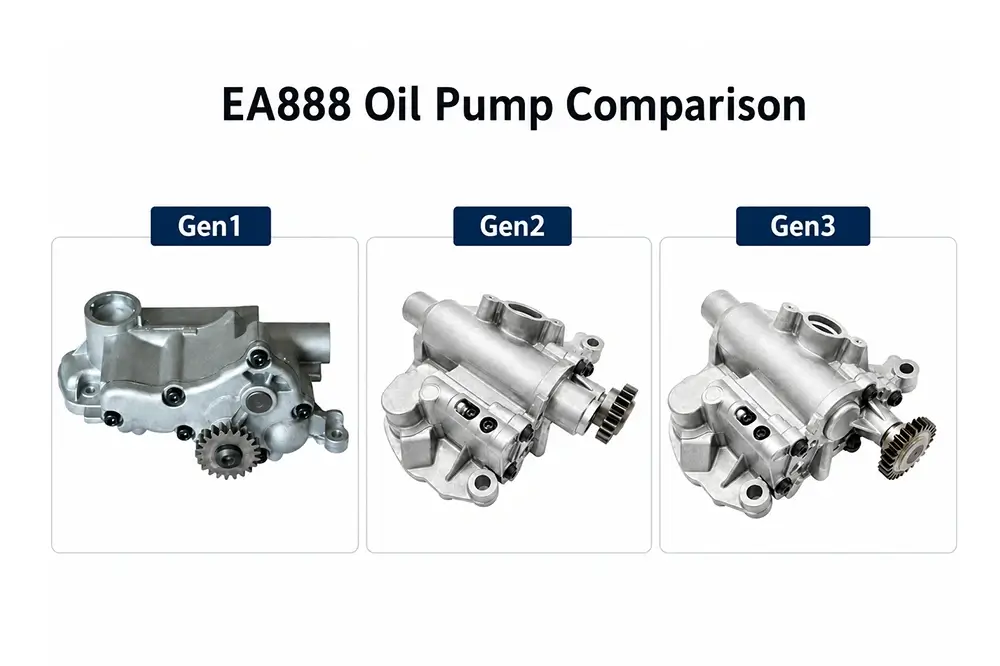
EA888 oil-pump design evolved across the first three engine generations, but the changes were not a simple replacement of three completely unrelated pump types. In Audi’s documented CCTA/CBFA first-generation configuration, the engine uses an earlier single-stage oil-pressure system. The CAEB second-generation engine introduced a self-regulating external-gear pump controlled by Oil Pressure Regulation Valve N428. Third-generation engines retained the same basic regulating principle while revising the internal hydraulic control, pump drive ratio and piston-cooling circuits.
These pumps must not be assumed to interchange across generations. Final fitment should be confirmed by engine code, VIN, complete OE number and physical comparison of the mounting face, oil passages, pump drive and electrical control components.
The generation descriptions in this article are based on Audi’s documented CCTA/CBFA, CAEB and third-generation EA888 examples. Transverse and longitudinal layouts, market versions, engine codes and production revisions may use different pump configurations.
No. EA888 oil pump from different generations must not be assumed to interchange. However, Gen 2 and Gen 3 regulated pumps are not completely unrelated designs. Audi states that the third-generation pump retains a similar operating principle while using revised hydraulic control and a different pump drive ratio.
Even within one EA888 generation, different engine codes may use different pump versions. Variations can occur because of:
vehicle platform;
engine displacement;
market specification;
production date;
pressure-control strategy;
lower-engine packaging and the relationship between the pump, oil pan and surrounding drive components;
pump drive arrangement;
emissions and efficiency requirements.
A pump that fits the bolt holes may still be incorrect if its oil passages, drive gear or pressure-control configuration do not match the engine.
The EA888 family includes several generations of turbocharged petrol engines used across Volkswagen Group vehicles. The generation name is useful for narrowing the application, but it should not be used as the only fitment reference.
In Audi’s documented CCTA/CBFA first-generation configuration, the engine uses an earlier single-stage oil-pressure system rather than the N428-controlled self-regulating system introduced on the CAEB engine.
The documented early system uses one oil-pressure switch. Its pressure-monitoring and pump-control arrangement are therefore simpler than the later two-stage system, which uses N428 together with F22 and F378.
Representative early EA888 applications may use pumps from the 06J 115 105 OE-number family. Volkswagen’s official parts data confirms 06J 115 105 AG as a replacement for 06J 115 105 AB in specified CBFA and CCTA applications.
For Gen 1 pump identification, check:
the complete original OE number and suffix;
the engine code;
the VIN and production date;
the mounting face;
the oil inlet and outlet arrangement;
the pump sprocket and chain configuration;
the oil-pressure switch specification.
This description applies to the documented CCTA/CBFA configuration. It must not be treated as a universal specification for every early EA888 engine worldwide.
In Audi’s documented CAEB second-generation configuration, the main lubrication-system development is the introduction of a self-regulating external-gear oil pump.
The driven pump gear moves axially in relation to the drive gear. Changing the effective engagement width alters pump delivery and allows oil pressure to be regulated according to engine operating conditions.
The documented CAEB system includes:
a self-regulating external-gear pump;
an axially displaceable driven pump gear;
Oil Pressure Regulation Valve N428;
Reduced Oil Pressure Switch F378;
Oil Pressure Switch F22;
separate low- and high-pressure operating stages.
N428 is therefore not exclusive to EA888 Gen 3. It is already a core component of the documented CAEB Gen 2 oil-pressure system.
Selected Gen 2 applications use different 06H 115 105-series pumps. However, the complete suffix must be checked because pumps sharing the same basic number may have different housings, oil passages, control mechanisms or vehicle applications.
This CAEB configuration is the official Gen 2 example used in this article. Other Gen 2 engine codes and layouts still require separate OE and fitment verification.
The third-generation regulated oil pump retains the basic operating principle of the second-generation self-regulating pump. It should therefore be described as an evolution of the Gen 2 design rather than a completely unrelated pump concept.
Audi identifies two main pump changes:
revised internal hydraulic control for more precise oil-flow regulation;
a revised pump drive ratio of i = 0.96, allowing the pump to operate at a lower speed.
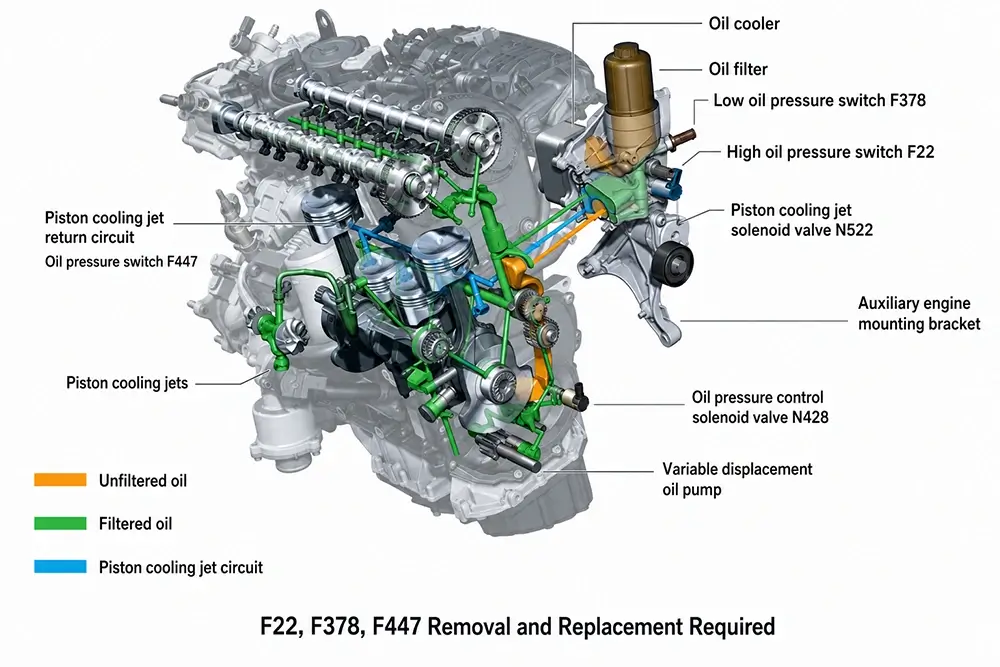
The surrounding lubrication system was also expanded. Relevant Gen 3 engines use:
Oil Pressure Regulation Valve N428;
Reduced Oil Pressure Switch F378;
Oil Pressure Switch F22;
Piston Cooling Nozzle Control Valve N522;
Oil Pressure Switch Level 3 F447;
switchable piston-cooling jets.
F447 monitors the piston-cooling oil gallery. It is not another general low- or high-pressure switch for the main lubrication circuit.
In the documented system, energising N522 closes the piston-cooling oil gallery through the mechanical switching valve. When N522 is de-energised, the gallery opens and the piston-cooling jets operate.
Gen 3 still includes different engine codes and production variants, so the generation name alone is insufficient for ordering a replacement pump.
| Comparison item | EA888 Gen 1: documented CCTA/CBFA example | EA888 Gen 2: documented CAEB example | EA888 Gen 3: documented Audi example |
| Oil-pump system | Earlier single-stage system | Self-regulating external-gear pump | Regulated pump based on the Gen 2 operating principle |
| Delivery control | Conventional single-stage delivery | Axially displaceable driven pump gear | Revised internal hydraulic control |
| Pressure stages | Single stage | Low- and high-pressure stages | Revised regulated pressure stages |
| N428 regulation valve | Not used in the documented early system | Used | Used |
| F22 oil-pressure switch | Used | Monitors the high-pressure stage | Used |
| F378 reduced-pressure switch | Not used in the documented single-stage system | Used | Used |
| F447 pressure switch | Not used | Not documented in the baseline CAEB system | Monitors the piston-cooling oil gallery |
| N522 control valve | Not used | Not documented in the baseline CAEB system | Controls the switchable piston-cooling circuit |
| Piston cooling | Conventional system | Conventional system in the documented example | Electronically switchable circuit |
| Pump drive | Engine-code-specific chain drive | Chain-driven pump | Revised drive ratio of i = 0.96 |
| Representative OE family | Selected 06J 115 105 variants | Selected 06H 115 105 variants | Selected later 06H 115 105 variants |
| Final fitment basis | Engine code, VIN and complete OE number | Engine code, VIN and complete OE number | Engine code, VIN, complete OE number and control-system configuration |
These columns describe the specific official engine examples documented by Audi. They are not universal specifications for every EA888 engine sold worldwide.
The OE families shown are representative examples rather than a universal interchange list. Complete suffixes, official supersession data and vehicle-specific fitment must be checked separately.
The most important documented design change occurs between the earlier single-stage system and the Gen 2 CAEB variable displacement oil pump.
In the Gen 2 pump, the driven external gear moves axially in relation to the drive gear. This changes the effective engagement width and therefore alters pump delivery.
The Gen 3 pump retains this basic regulating principle but uses revised internal hydraulic control.
The documented regulated-pump components include:
the drive pump gear;
the axially displaceable driven pump gear;
the displacement unit;
the control piston;
the control spring;
the cold-start valve;
the retention valve;
the internal mesh oil filter.
Housing shape, mounting holes, oil passages, casting ribs, sprocket dimensions and valve locations remain OE-specific identification points. They should not be assigned universally to an entire generation without official parts-catalogue evidence.
Audi’s documented technical progression is:
an earlier single-stage system in the CCTA/CBFA example;
an N428-controlled self-regulating two-stage pump in the CAEB example;
a Gen 3 regulated pump that retains the Gen 2 operating principle but uses revised hydraulic control and an expanded piston-cooling circuit.
In the CAEB system, N428 changes the hydraulic condition acting on the pump control mechanism. The pump alters delivery through axial movement of the driven gear.
F378 and F22 monitor different pressure conditions:
F378 checks the reduced-pressure stage;
F22 checks the high-pressure stage.
Gen 3 retains N428, F378 and F22 while adding N522 and F447 for the switchable piston-cooling circuit.
N428 is a regulation valve. F22, F378 and F447 are pressure-monitoring switches with different functions.
Audi’s Gen 3 documentation confirms that the pump drive ratio was revised to i = 0.96, allowing the oil pump to operate at a lower speed.
Other details such as sprocket diameter, tooth count, material, offset and shaft design are OE-specific. They should not be treated as fixed characteristics of an entire EA888 generation.
During fitment verification, compare:
sprocket diameter;
tooth count;
sprocket offset;
chain alignment;
shaft position;
retaining method;
the relationship between the sprocket and pump housing.
A matching mounting face does not prove that the pump drive is compatible.
The mounting face should be compared carefully.
Check:
the number of mounting holes;
bolt-hole spacing;
threaded and unthreaded holes;
locating dowels;
mounting-face height;
housing ribs;
sealing surfaces;
contact points with the engine block or module;
• clearance around the sump and related components.
Small differences can prevent correct installation or create oil leakage.
A pump that appears to fit may still sit incorrectly if the mounting height or locating points differ.
Oil-channel alignment is one of the most important reasons not to interchange pumps based only on appearance.
Compare:
oil inlet position;
pressure outlet position;
control-oil passages;
regulating-valve passages;
piston-cooling circuits;
sealing grooves;
O-ring positions;
internal gallery shape.
Similar bolt patterns do not guarantee identical oil-passage alignment.
If an oil passage is partially blocked or incorrectly aligned, the engine may experience:
delayed oil-pressure build-up;
low pressure at idle;
incorrect pressure-stage operation;
insufficient lubrication;
pressure-switch faults;
piston-cooling problems.
This is why the mounting face should be photographed and compared before a replacement is confirmed.
Relevant EA888 systems may use several electrical and hydraulic components.
F22 Oil Pressure Switch
On the documented CAEB self-regulating system, F22 monitors the high-pressure stage. Earlier engines without the self-regulating pump also use an F22 switch, but its part number and pressure specification may differ.
F378 Reduced Oil Pressure Switch
F378 is used with the self-regulating pump to confirm the reduced-pressure condition. It is documented on the CAEB Gen 2 system and retained on the Gen 3 system.
N428 Oil Pressure Regulation Valve
N428 controls the hydraulic switching function of the regulated oil pump. It is present in the documented CAEB Gen 2 system and is not a Gen 3-only component.
F447 Oil Pressure Switch Level 3
On the documented Gen 3 system, F447 is located in the piston-cooling oil circuit and monitors whether pressure is present in that gallery.
N522 Piston Cooling Nozzle Control Valve
N522 controls the switchable piston-cooling circuit. When N522 is energised, the mechanical switching valve closes the piston-cooling gallery. When N522 is de-energised, the gallery opens and the piston-cooling jets operate.
These components must not be identified or ordered by connector colour alone. Confirm the engine code and complete OE number.
An EA888 Gen 2 engine oil pump must not be assumed to interchange with a Gen 3 pump. Audi’s technical documentation shows that the Gen 3 pump retains the Gen 2 regulating principle but uses revised hydraulic control and a different pump drive ratio. The Gen 3 lubrication system also adds a switchable piston-cooling circuit with N522 and F447.
The supplied physical samples additionally show differences in upper housing passages, regulating structures and mounting-face oil-channel layout.
These findings demonstrate that the systems and samples are not automatically interchangeable. However, the comparison applies to the specific pump versions shown. Actual interchangeability must be confirmed through the Volkswagen Group parts catalogue using the engine code, VIN and complete OE number.
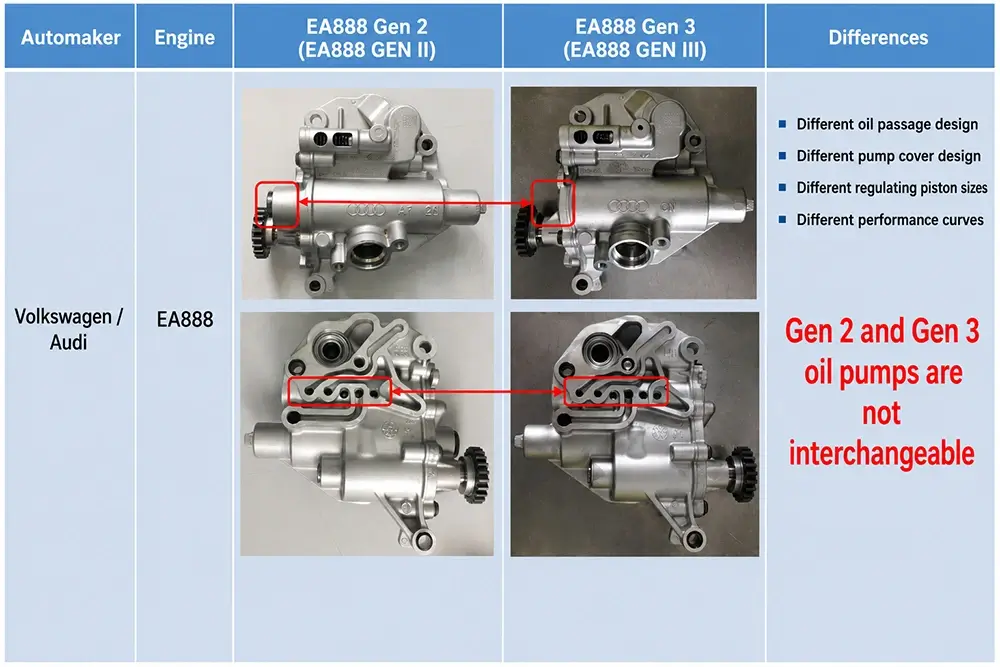
The supplied Gen 2 and Gen 3 oil-pump samples show visible differences in:
·upper housing flow passages;
·pump-cover design;
·regulating-piston area;
·mounting-face oil-channel layout;
·housing dimensions and external shape.
These differences show that the specific samples are not directly interchangeable.
However, the comparison applies to the pump versions shown. It must not be used as proof that every Gen 2 and every Gen 3 oil pump follows the same external design. Final fitment still requires engine-code, VIN and complete OE-number verification.
Do not identify the engine only as:
1.8 TSI;
2.0 TSI;
2.0 TFSI.
The engine code gives a more accurate application reference.
The same vehicle model may have different engine codes in different years or markets.
Clean the original pump and record all visible numbers.
Check for:
OE number;
suffix letters;
superseded numbers;
casting marks;
date code;
batch code;
supplier marking.
A suffix change may indicate an updated pump rather than an unrelated part, but this must be confirmed through reliable catalogue data. A basic number such as 06H 115 105 is incomplete. Record the full suffix and distinguish between an original number, an official supersession and a third-party cross-reference.
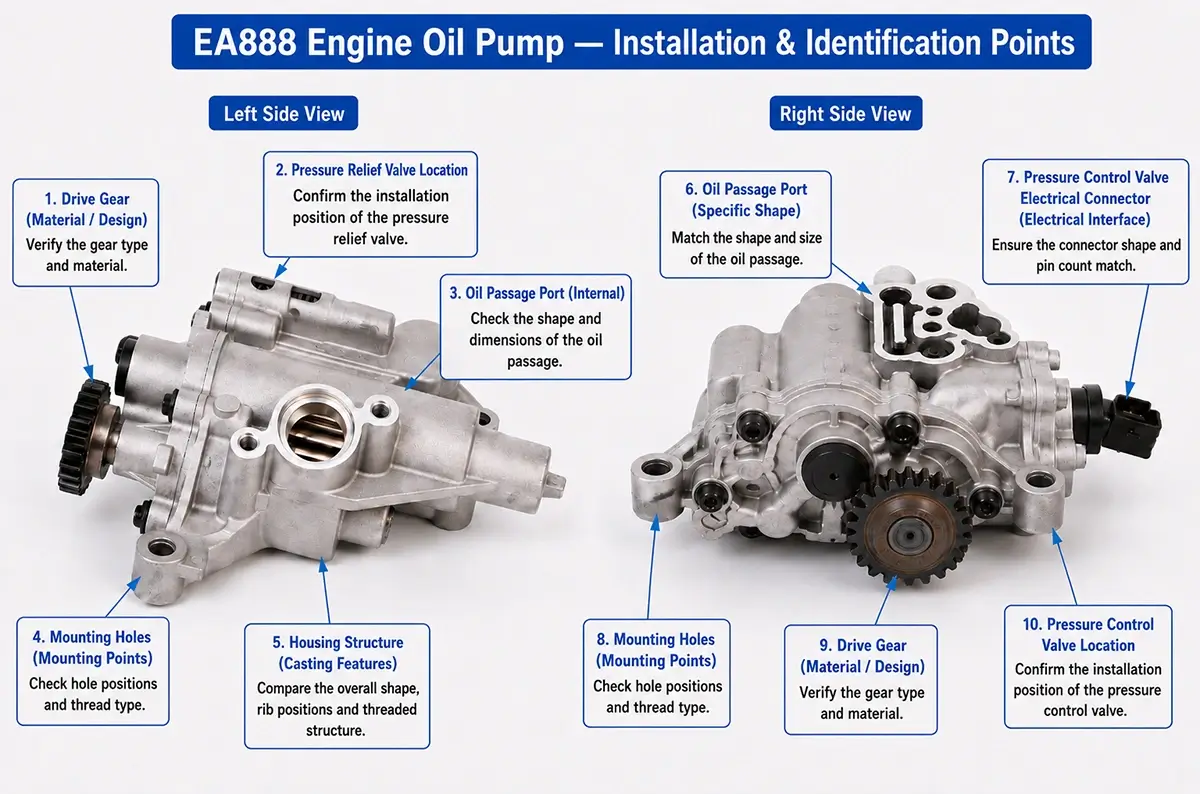
Place the original and replacement pumps in the same orientation.
Compare:
bolt holes;
threaded holes;
locating points;
sealing surfaces;
housing height;
surrounding clearances.
Do not compare only the external side view.
Photograph the mounting surfaces clearly.
Check:
number of oil ports;
port size;
port shape;
channel position;
O-ring grooves;
control passages.
Even one mismatched passage can make the pump unsuitable.
Check the sprocket diameter, tooth count, offset, shaft position, chain alignment and retaining method. These are OE-specific fitment checks and should not be treated as fixed characteristics of an entire EA888 generation.
onfirm whether the original system uses an N428-controlled regulated pump. Compare the valve part number, connector shape, pin arrangement, mounting position and related oil passages. The presence of an electrical connector alone does not prove compatibility.
Use the following as supporting information:
VIN;
model;
production year;
market;
transmission type where relevant;
engine production date.
This information helps identify mid-year or production changes.
Selected early EA888 applications use 06J 115 105-series pumps. Official Volkswagen parts data confirms 06J 115 105 AG as a replacement for 06J 115 105 AB in specified CBFA and CCTA applications.
Other suffixes shown in supplier catalogues must be verified separately and should not automatically be treated as official interchangeable numbers.
Selected Gen 2 applications use different 06H 115 105 variants. The complete suffix must be checked because a shared basic number does not prove that the pump housing, oil passages, pressure-control system or application is identical.
Selected Gen 3 applications also use 06H 115 105 variants. Some suffixes have verified official supersession relationships, while others shown in supplier catalogues require separate VIN and OE verification.
06H 115 105 is a base number family, not a complete fitment reference. The suffix is essential.
| Required information | Purpose |
| Engine code | Identifies the specific EA888 application |
| EA888 generation | Narrows the pump family |
| Original OE number | Provides the primary cross-reference |
| VIN | Supports catalogue verification |
| Vehicle model and year | Helps identify production changes |
| Mounting-hole pattern | Prevents housing mismatch |
| Oil-passage layout | Confirms lubrication compatibility |
| Drive-gear details | Confirms mechanical compatibility |
| Control-valve connector | Confirms electrical compatibility |
| Original pump photographs | Supports visual comparison |
For difficult applications, provide photographs of:
the front side;
the mounting face;
the drive gear;
the electrical connector;
the casting number;
the oil ports;
the original vehicle label or engine code.
One vehicle model can use several engines across different years and markets.
“2.0 TSI” covers many EA888 engine codes and pump versions.
EA888 is an engine family with several generations and production revisions.
A suffix may indicate a design update, production revision or different application.
Internal galleries and control systems may differ even when the housing looks similar.
The oil ports and sealing surfaces are often more important than the external appearance.
Later regulated systems require the correct valve and connector configuration.
The drive and pressure-control systems may be different.
Third-party catalogues can contain incomplete or overly broad application data.
For workshops, distributors and importers, fitment accuracy is only one part of the purchasing decision.
A supplier should be able to provide:
clear OE cross-reference data;
engine-code applications;
high-resolution product photographs;
mounting-face photographs;
batch identification;
packaging labels;
pressure-test information;
leakage-test information;
traceability records;
warranty procedures.
Inspect:
porosity;
cracks;
damaged sealing faces;
machining marks;
burrs inside oil passages;
incorrect thread depth;
uneven mounting surfaces.
Oil pumps must be free from:
casting sand;
metal chips;
dirt;
packaging debris;
excess machining residue.
Contamination inside a new pump can damage the engine immediately after installation.
Check:
tooth finish;
surface damage;
gear alignment;
hardness documentation where available;
secure fitment to the pump shaft.
The package should protect:
mounting faces;
gear teeth;
connectors;
machined oil ports;
valve openings.
Protective caps should remain in place until installation.
☐ The engine code matches the application.
☐ The EA888 generation has been identified.
☐ The original OE number has been checked.
☐ Superseded part numbers have been verified.
☐ The mounting-hole pattern matches.
☐ The housing height and shape match.
☐ The oil-passage layout matches.
☐ Sealing grooves and O-ring locations match.
☐ The drive gear matches in diameter and tooth count.
☐ The control-valve connector matches.
☐ Pressure-switch and valve locations are correct.
☐ The supplier has provided traceability information.
☐ The pump is clean and undamaged.
☐ Related seals and one-time-use fasteners are available.
They must not be assumed to interchange. The documented systems differ in pressure regulation, hydraulic control, pump drive and supporting oil circuits. Final compatibility requires engine-code, VIN and complete OE-number verification.
Use the engine code, original OE number and physical comparison of the mounting surface, oil passages, drive gear and control-valve connector when selecting the correct VW oil pump.
No. Vehicle year is only a supporting reference. Different engines and pump revisions may be used within the same model year.
No. The Gen 3 pump retains a similar regulating principle, but Audi revised its hydraulic control and pump drive ratio. The Gen 3 system also includes additional piston-cooling control components.
They may differ internally or in their oil channels, drive configuration, pressure-control mechanism or engine-code application.
No. N428 is an oil-pressure regulation valve on relevant systems. Separate pressure switches monitor pressure conditions.
It should not be assumed. The gear, shaft, drive ratio and retention method must be verified before any component is transferred.
Request OE cross-reference data, engine-code fitment, clear product photographs, test information, batch traceability, packaging details and warranty procedures.
No. Audi’s documented CAEB Gen 2 system already uses N428 to regulate the self-regulating oil pump.
No. 06H 115 105 is only the base number family. The complete suffix, engine code, VIN, housing, oil passages and control configuration must match.
The documented CCTA/CBFA Gen 1 example uses an earlier single-stage system, while the CAEB Gen 2 example uses an N428-controlled self-regulating external-gear pump with separate low- and high-pressure monitoring.

 English