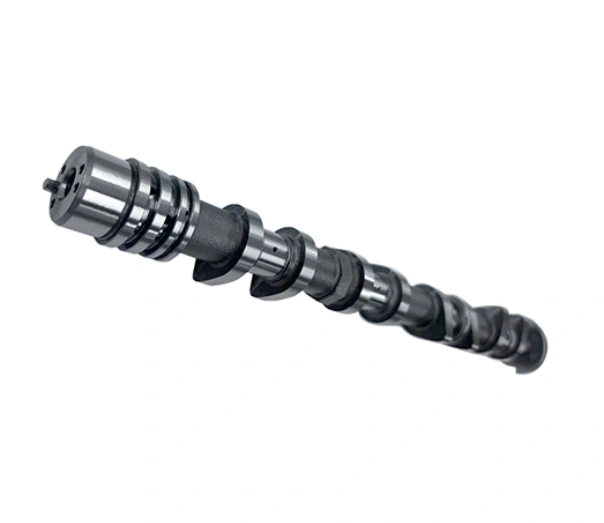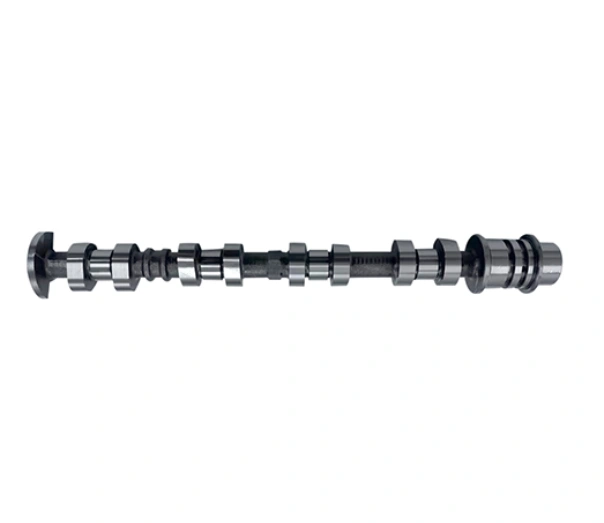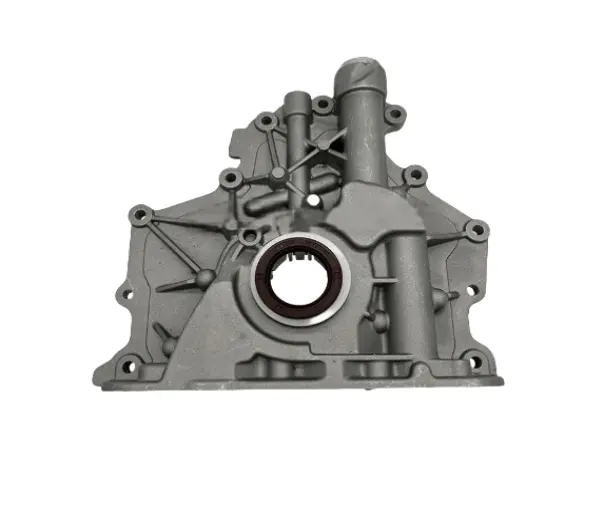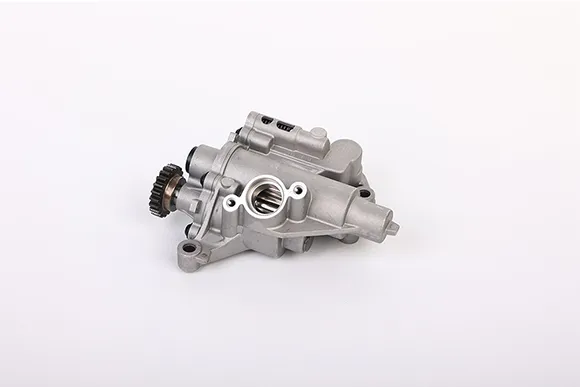
An EA888 low oil pressure at idle warning that appears after the engine has warmed up should not be treated as proof that the oil pump has failed. A weak EA888 oil pump is one possibility, but the same warning can result from an incorrect oil level, unsuitable oil, a restricted pickup, a faulty pressure switch, an oil-pressure regulation fault or excessive internal engine clearance.
The first task is to confirm whether the engine has genuinely lost mechanical oil pressure. Replacing the pump before taking pressure readings can leave the original fault unresolved and add unnecessary parts and labour costs.
A red oil-pressure warning may indicate inadequate lubrication. Switch the engine off and investigate the fault rather than continuing to drive until noise or performance symptoms appear.
Oil pressure is produced when the oil pump moves lubricant through restricted galleries and bearing clearances. Pressure therefore depends on several conditions:
pump speed and displacement;
oil temperature and viscosity;
oil level and condition;
pickup and filter restriction;
pressure-control operation;
bearing and lubrication clearances;
the design of the specific EA888 generation.
At idle, the pump turns relatively slowly. Once the engine is hot, the oil flows more easily and leakage through worn pump components or enlarged bearing clearances becomes more significant. Some EA888 engines use a variable displacement oil pump design, which adjusts oil output according to engine operating conditions. A marginal lubrication system may therefore meet the required pressure when cold or at higher engine speed but fall below the monitoring threshold at hot idle.
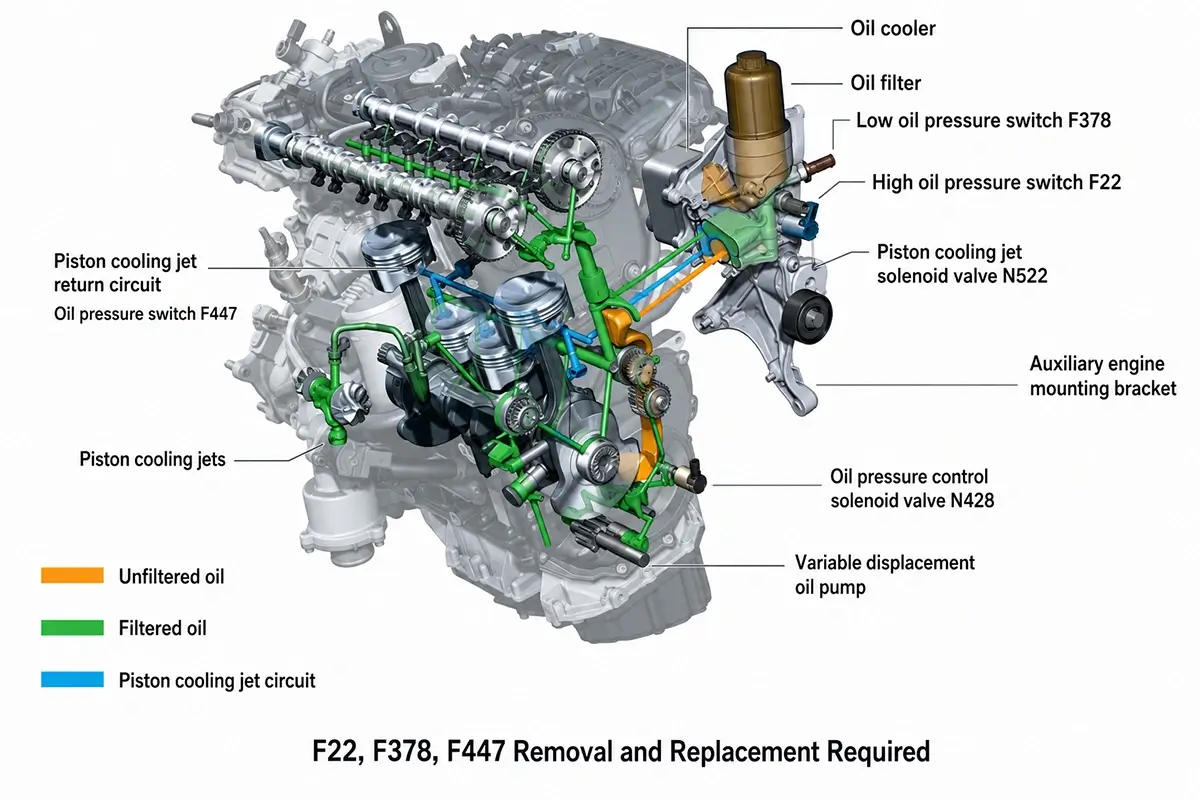
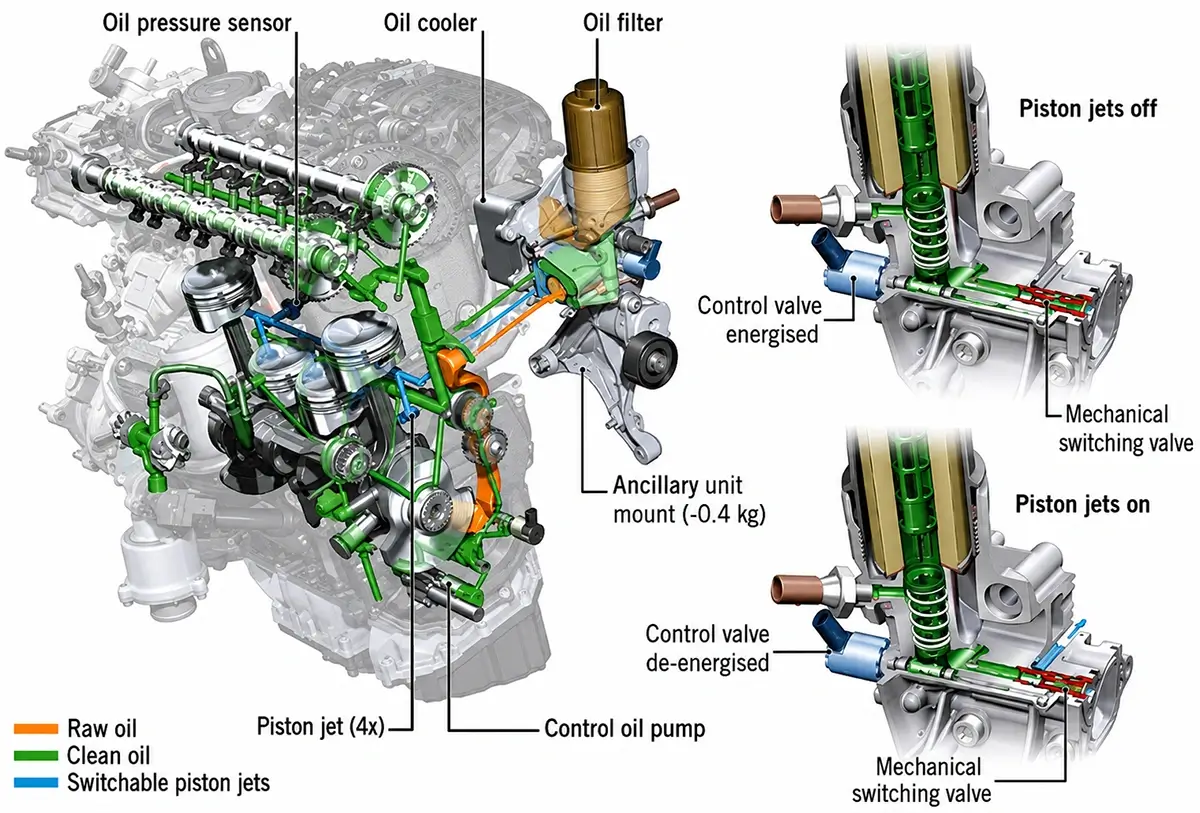
Audi technical material for third-generation EA888 engines shows a regulated oil pump, Oil Pressure Regulation Valve N428 and several pressure-monitoring switches within the lubrication circuit. It also distinguishes between low- and high-pressure circuits. This is why a warning can involve pump output, pressure regulation or signal monitoring rather than one component alone.
Do not apply one pressure specification to every 1.8 TSI, 2.0 TSI or 2.0 TFSI engine. The test temperature, engine speed, pressure stage and minimum acceptable reading must be taken from repair information for the exact engine code.
No single symptom confirms an oil-pump fault. The operating condition in which the warning appears is often more useful than the warning alone.
| Symptom | Possible direction | First useful check |
| Red oil-pressure warning at hot idle | Genuine low pressure or incorrect monitoring signal | Mechanical pressure test |
| Warning disappears when engine speed rises | Marginal idle pressure or speed-dependent signal issue | Compare hot-idle and raised-speed readings |
| Cold engine is normal but hot engine triggers the warning | Pump wear, oil condition or excessive internal clearance | Check oil specification and measure hot pressure |
| Warning follows an oil-filter housing repair | Missing, incorrect or displaced valve or component | Recheck the repaired housing and transferred parts |
| Warning is accompanied by ticking or timing-chain noise | Possible inadequate lubrication or a separate timing fault | Switch off and verify pressure before further running |
| Mechanical pressure is correct but the warning remains | Pressure switch, wiring, connector or control-system fault | Electrical and signal diagnosis |
| Pressure remains low at idle and higher engine speed | Pickup restriction, pump fault or substantial internal leakage | Inspect sump, pickup and pump circuit |
| Pressure-stage fault code is stored | Control valve, switching mechanism or pressure-monitoring fault | Scan-tool and circuit tests |
A Volkswagen technical tip documents a case in which a replacement oil-filter housing did not include a mechanical oil-control valve. Failure to transfer that valve caused DTC P168C. This is a useful reminder that an oil-pressure fault appearing after previous repair work may be caused by an omitted component rather than a worn pump.
Hot-idle faults usually expose a system that has little remaining pressure margin.
Warm oil moves through the engine more easily than cold oil. This reduces resistance within the lubrication system. If pump efficiency has fallen or engine clearances have increased, hot pressure may drop below the required level even though cold-start pressure appears acceptable.
This does not mean thicker oil is a repair. Using an unsuitable viscosity can alter lubrication, cold-flow behaviour and pressure-control operation. Confirm the oil specification required for the engine before changing viscosity.
Oil-pump output changes with engine speed and pump-control strategy. A system that produces adequate pressure at 2,000 rpm may still be unable to maintain the specified pressure at hot idle.
The fact that a warning disappears when the throttle is opened does not isolate the pump. Higher engine speed can also compensate temporarily for:
enlarged bearing clearances;
a partially restricted pickup;
internal pump leakage;
a pressure-regulation problem;
oil that has been diluted or incorrectly specified.
Oil pressure is lost as oil passes through bearing and lubrication clearances. Wear in crankshaft main bearings, connecting-rod bearings, balance-shaft bearings or other lubricated areas can increase this leakage.
Installing a new pump may raise flow, but it will not correct excessive clearances elsewhere in the engine.
The dashboard warning is the start of the diagnosis, not the final result.
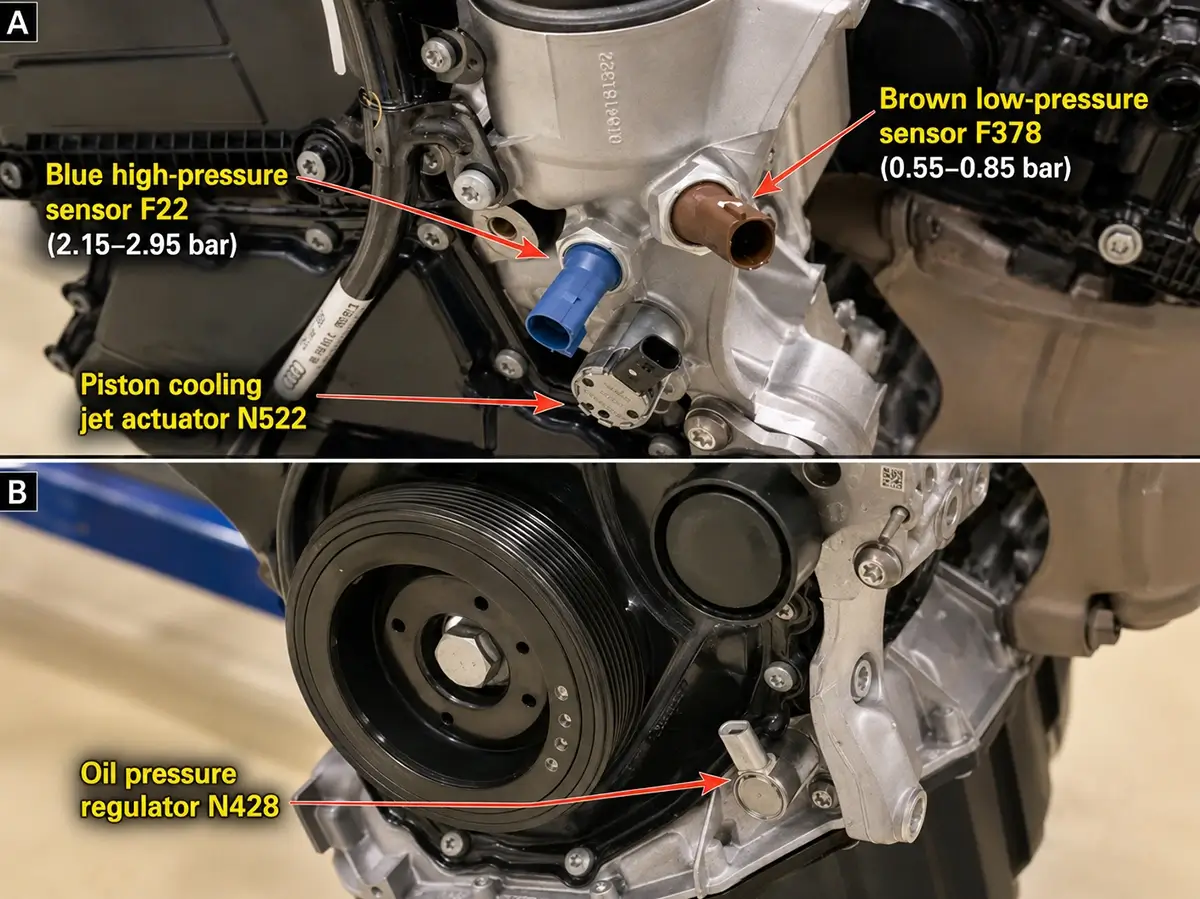
An EA888 oil-pressure system may use several switches and electronically controlled elements. Third-generation Audi EA888 documentation identifies the regulated pump, N428 regulation valve, F22 pressure switch, F378 reduced-pressure switch and F447 pressure switch for the piston-cooling circuit. The exact combination varies by engine and application.
A workshop should therefore answer two separate questions:
Is the actual mechanical oil pressure below specification?
Is the monitoring and pressure-control system reporting and controlling it correctly?
Replacing a sensor without measuring pressure risks overlooking genuine lubrication loss. Replacing the pump without checking the electrical system risks replacing an operational pump.
Before removing parts, establish when the fault occurs.
Record:
engine code;
EA888 generation;
vehicle model and production year;
engine oil temperature;
coolant temperature;
engine speed;
whether the warning appears cold or hot;
whether it disappears above idle;
whether the fault occurs during braking, cornering or acceleration;
any engine noise;
stored and pending fault codes;
recent oil-system or timing-system repairs.
Intermittent faults become easier to diagnose when the workshop can reproduce the same temperature and speed conditions.
A warning that appears immediately after an oil-filter housing, sump or oil-pump repair should trigger an inspection of the previous work before additional components are ordered.
Confirm the basic service conditions before interpreting pressure readings.
Inspect for:
oil level below the permitted range;
excessive oil level;
incorrect viscosity;
oil that does not meet the required Volkswagen specification;
fuel dilution;
coolant contamination;
heavy sludge;
an overdue service interval;
an incorrect, damaged or collapsed filter element;
leakage from the sump, filter housing, cooler or pressure switches.
Low oil level can allow the pickup to draw air. Excessive oil level can cause aeration or indicate fuel or coolant contamination.
An oil change may be justified when the oil is incorrect or contaminated, but it should not be used to avoid pressure testing when a red warning has already appeared.
Read the complete fault memory rather than searching for one expected oil-pump code.
Relevant fault groups may include:
oil-pressure switch circuit faults;
implausible pressure-switch signals;
oil pressure below the permitted threshold;
oil-pressure regulation faults;
N428 circuit faults;
piston-cooling pressure monitoring faults;
camshaft timing or adjustment faults;
engine-speed limitation or protection responses.
Record freeze-frame information before clearing codes.
A circuit code may indicate an open circuit, short circuit, incorrect component or connector problem. It does not prove that mechanical pressure is correct. A low-pressure code may also be secondary to an oil-supply or internal engine fault.
This is the central test.
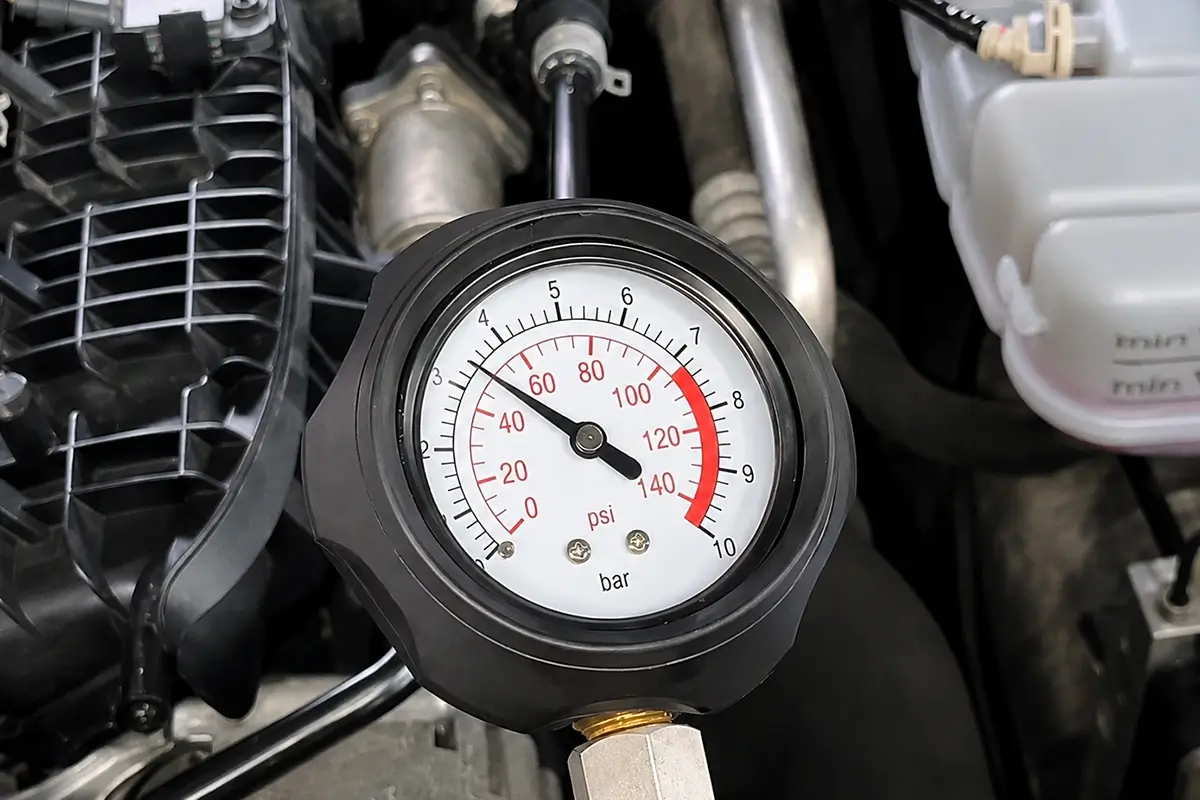
Fit a suitable mechanical gauge at the specified test connection using the correct adapter. Carry out the procedure from the repair information for the engine code.
The technician should record:
pressure during cold start, where specified;
pressure at the required oil temperature;
hot-idle pressure;
pressure at the specified raised engine speed;
whether the system changes pressure stage correctly;
whether the reading is stable or fluctuates.
Do not compare a hot-idle reading with a specification intended for a different temperature or engine speed.
Do not rely on a verbal statement that the pressure is “fine”. Retain the measured values and test conditions on the job record.
When mechanical pressure is within specification, investigate the monitoring circuit.
Check:
oil contamination inside the connector;
damaged terminal locks;
corroded terminals;
stretched or broken wiring;
wiring routed against hot or moving parts;
an incorrect pressure switch;
an aftermarket switch with the wrong switching threshold;
a loose switch or sealing issue;
a signal that changes incorrectly when pressure is applied.
EA888 configurations may use more than one pressure switch. Confirm which switch is associated with the stored fault and which pressure stage it monitors.
Parts should be matched by engine code and OE reference rather than thread size or external appearance alone.
N428 is part of the pressure-control system on relevant EA888 versions. It interacts with the regulated oil pump rather than acting as a simple pressure sensor. Audi documentation places N428 directly in the oil-pump regulation circuit.
Diagnosis may include:
checking the power supply;
verifying ground and circuit integrity;
inspecting connector condition;
carrying out an actuator test where supported;
checking for installation damage;
inspecting for contamination or valve sticking;
confirming that the fitted valve matches the engine.
A resistance measurement can identify some electrical faults, but it does not establish that the hydraulic section moves freely or that the pump changes displacement correctly.
Do not confuse N428 with the oil-pressure switches or the piston-cooling nozzle control valve. They have different functions and require different tests.
If measured pressure is low, inspect the suction side before condemning the pump.
Possible restrictions or leaks include:
sludge on the pickup screen;
excess sealant;
carbon or plastic debris;
metallic particles;
a damaged pickup pipe;
a leaking pickup seal;
a cracked connection;
a distorted sump;
incorrect sump installation;
oil aeration.
A restricted pickup reduces the oil available to the pump. A suction-side leak may allow the pump to draw air, especially under conditions where the oil is hot or moving within the sump.
Metallic debris requires more than cleaning the screen. Identify its source before installing a replacement pump.
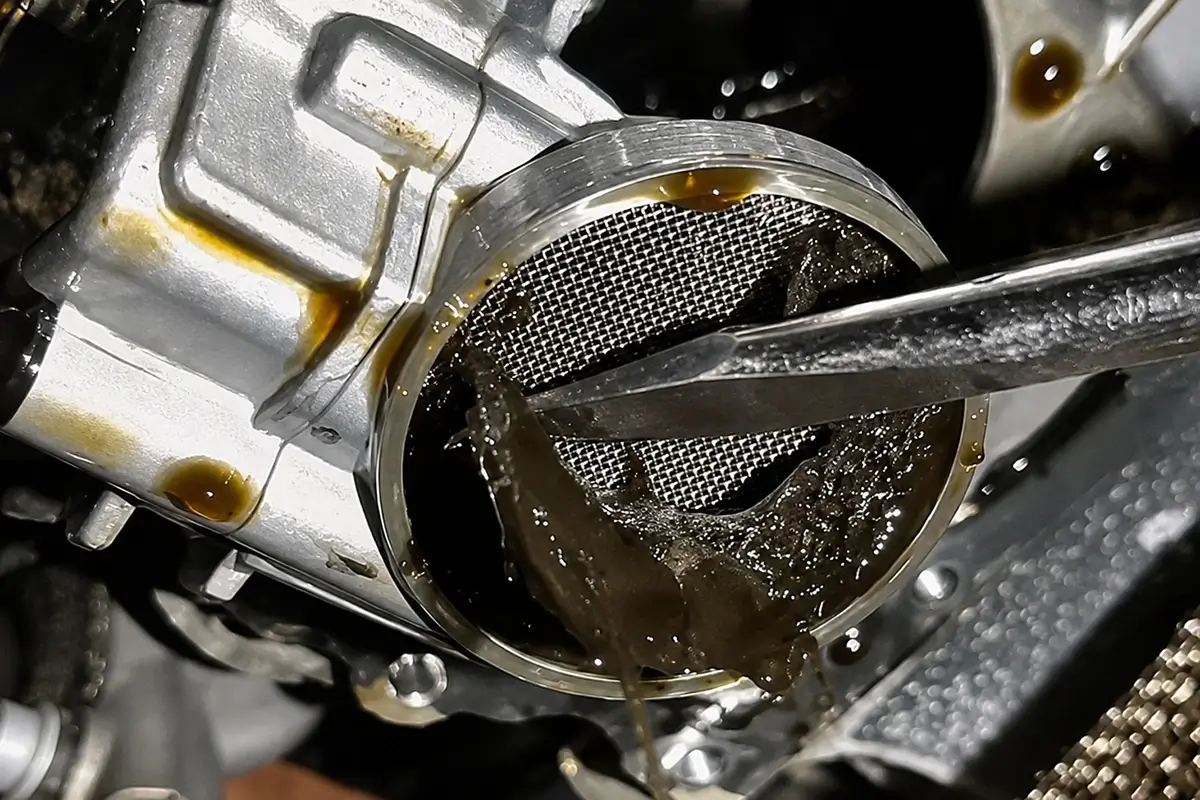
Oil-pump inspection should cover more than visible damage to the housing.
Check the relevant components for:
scoring or wear inside the pump;
a sticking displacement mechanism;
pressure-regulation piston wear;
spring damage;
a sticking cold-start valve;
damaged pump gears;
excessive internal clearance;
blocked pump inlet mesh;
drive-chain wear;
sprocket damage;
tensioner faults;
incorrect assembly;
oil-channel sealing problems.
Audi's third-generation EA888 material describes an axially adjustable driven pump gear, control piston, retention valve, cold-start valve and internal mesh filter. It also notes that the third-generation regulated pump differs from the second-generation unit in its hydraulic control and drive ratio.
This is another reason not to treat every EA888 pump as the same part.
If the pickup is clear and the pump is serviceable, low hot pressure may come from the engine itself.
Inspect further when:
metallic or bearing material is found in the sump;
hot pressure is low across several engine speeds;
the engine has operated with insufficient oil;
knocking accompanies the warning;
pressure remains low after pump replacement;
the engine has high mileage or an uncertain repair history.
Potential leakage areas include:
crankshaft main bearings;
connecting-rod bearings;
balance-shaft bearings;
camshaft bearing surfaces;
damaged lubrication galleries;
incorrectly fitted plugs or valves;
internal oil leaks following previous engine work.
Bearing clearance must be measured using an appropriate engine-repair procedure. Do not assume that a new pump will compensate for an engine that requires mechanical repair.
Use the complete test pattern rather than one warning or one reading.
| Test result | More likely direction |
| Mechanical pressure is correct but the warning remains | Switch, connector, wiring or monitoring logic |
| Cold pressure is acceptable but hot-idle pressure is low | Pump wear, oil condition or excessive clearance |
| Pressure is low at idle and raised speed | Pickup restriction, pump failure or substantial internal leakage |
| Pressure is unstable | Aeration, suction leak, intermittent restriction or regulation fault |
| The commanded pressure stage does not change | N428 circuit, regulation mechanism or pump fault |
| Fault appeared after filter-housing replacement | Missing or incorrectly transferred valve or housing component |
| New pump does not correct low pressure | Internal clearance, installation fault or unresolved restriction |
| Sump contains metallic particles | Internal wear; identify the source before fitting parts |
EA888 is an engine family, not one fixed oil-system specification. Different Volkswagen applications may use different VW oil pump designs depending on engine generation, displacement and pressure-control strategy.
Differences between applications can include:
pump design;
pump drive ratio;
pressure-control strategy;
balance-shaft arrangement;
oil sump design;
pickup shape;
filter housing;
number and location of pressure switches;
piston-cooling control;
N428 configuration;
OE references;
installation hardware.
Audi's third-generation training material states that the regulated pump’s hydraulic control and drive ratio were revised compared with the second-generation engine. It also documents switchable piston-cooling jets and separate oil-pressure monitoring points.
A repair procedure or replacement part confirmed for one EA888 generation should not be applied automatically to another.
Before testing or ordering, record the engine code from the vehicle data and verify it against the original component.
Replacement is reasonable when the diagnosis shows that the pump cannot maintain the required pressure or regulate pressure correctly.
A sound replacement decision normally includes the following evidence:
mechanical oil pressure is below the applicable specification;
oil level, viscosity and condition are correct;
the oil filter and housing are correctly assembled;
the pickup and suction path are not the primary restriction;
the pressure switches and wiring have been checked;
the pressure-regulation circuit has been tested;
the pump or its regulation mechanism shows wear, sticking or damage;
excessive engine clearance has been considered;
the replacement pump has been matched to the engine.
Do not replace the oil pump solely because:
a generic fault-code description mentions oil pressure;
the warning occurs at idle;
the pressure switch has already been replaced;
another vehicle with similar symptoms required a pump;
the engine is described only as “2.0 TSI”.
Removing an EA888 oil pump may expose related components that affect oil supply or create repeat labour if ignored.
Depending on the engine, inspect:
oil pickup pipe;
pickup seal;
sump and baffle;
N428 pressure-regulation valve;
pressure switches;
oil-filter housing;
mechanical control valves in the housing;
oil cooler seals;
pump drive chain;
drive sprocket;
chain tensioner;
balance-shaft components;
one-time-use fasteners;
sump sealant application;
timing components where access overlaps;
bearings when debris is present.
The required replacement package varies. Do not assume that an oil-pump assembly includes the control valve, pickup, seals or drive components.
Ordering by vehicle model alone creates avoidable fitment errors.
Confirm the following details:
| Ordering detail | Why it matters |
| Engine code | Identifies the specific EA888 application |
| EA888 generation | Pump design and regulation can differ |
| Engine displacement | 1.8 and 2.0 applications may not share the same pump |
| Vehicle model and year | Narrows production changes |
| VIN | Supports catalogue verification |
| Original OE number | Primary cross-reference point |
| Superseded OE numbers | Prevents rejection of a valid updated reference |
| Pump and balance-shaft configuration | Some assemblies differ in scope |
| N428 arrangement | Confirms pressure-control compatibility |
| Pickup and sump design | Affects inlet position and sealing |
| Drive sprocket and chain specification | Confirms mechanical compatibility |
| Mounting pattern | Prevents housing mismatch |
| Oil-channel layout | Prevents internal flow mismatch |
| Included parts | Clarifies whether seals, valves or pickup are supplied |
| Test and traceability records | Supports batch control and warranty handling |
For cross-reference checking, supply:
the original pump number;
engine code;
vehicle year;
VIN where available;
photographs of the original pump;
photographs of the mounting surface;
oil-port layout;
electrical connectors;
sprocket and drive side.
B2B buyers should also check packaging consistency, batch marking, warranty procedure and whether the supplier can trace production and test records. These controls reduce incorrect deliveries and make repeat orders easier to verify.
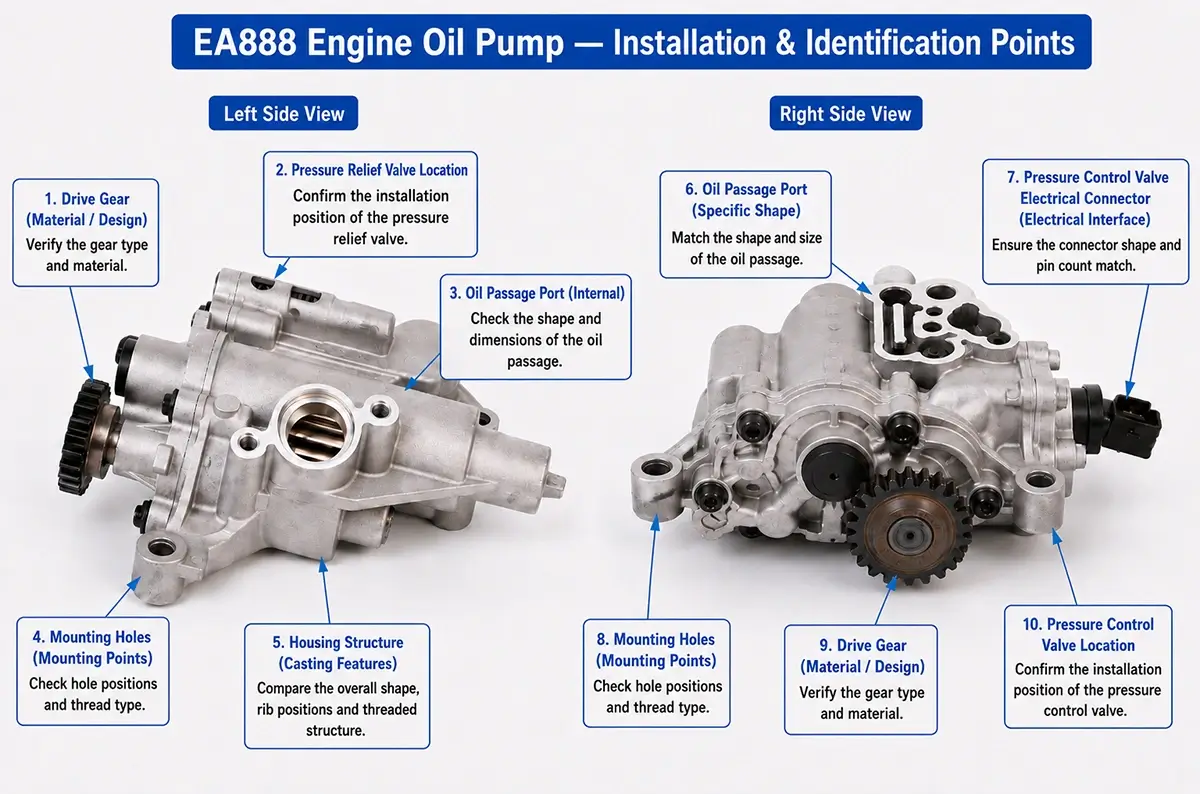
Before authorising an EA888 oil-pump replacement, confirm that the workshop has:
identified the engine code and generation;
documented when the warning occurs;
checked oil level and oil specification;
inspected the filter and housing;
scanned and saved all fault codes;
measured mechanical pressure when hot;
recorded idle and raised-speed readings;
checked the pressure switches and wiring;
tested N428 where applicable;
inspected the sump and pickup;
checked for metallic debris;
assessed pump drive components;
considered bearing and internal-clearance faults;
matched the replacement by OE number and physical configuration;
confirmed which seals, valves and drive parts are included.
A measured diagnostic sequence gives the buyer a clearer replacement specification and gives the workshop a defensible reason for replacing the pump.
The pump turns more slowly at idle, while hot oil is less viscous. Pump wear, a restricted pickup, excessive bearing clearance or a marginal pressure signal may therefore appear first when the engine is hot and idling.
No. Higher engine speed raises pump output, but it can also temporarily compensate for bearing wear, oil dilution, pickup restriction or a pressure-control problem. Mechanical pressure testing is needed.
Yes. A faulty switch, incorrect switching threshold, damaged connector or wiring fault can trigger a warning even when mechanical pressure is within specification.
On engines fitted with the relevant regulated oil-pump system, N428 can affect pressure regulation. Diagnosis should include the circuit, connector, actuator operation and hydraulic condition rather than replacing the valve from a fault-code description alone.
Yes. Sludge, sealant or debris can restrict oil supply to the pump. A leaking pickup seal may also allow air into the suction side. The sump and pickup should be inspected when measured pressure is low.
Not necessarily. Excessive main-bearing, connecting-rod bearing or other internal clearance can allow too much oil to escape from the pressure circuit. The engine may remain below specification after a new pump is installed.
Treat a red oil-pressure warning as a possible loss of lubrication. Switch the engine off and arrange diagnosis before further operation. Continuing to run the engine may damage bearings, camshafts, turbocharger components and timing-system parts.
Provide the engine code, EA888 generation, vehicle model, year, VIN, original OE reference and photographs of the pump’s mounting points, oil ports, electrical components and drive side.

 English