For diesel-engine parts distributors, repair networks, and aftermarket importers, choosing between metal and ceramic glow plugs is not simply a matter of selecting the newer technology. The correct choice depends on the engine’s original design, control voltage, required heating profile, installation dimensions, and OE reference.
Both metal and ceramic glow plugs help a diesel engine start under low-temperature conditions by heating the combustion area before and during ignition. However, their internal construction, heat-up behavior, operating temperature, and application requirements are different.
The practical answer is straightforward: buyers should select the glow plug specified for the engine rather than choosing ceramic or metal based only on perceived performance. A ceramic plug may offer faster heating and higher operating temperatures, while a metal plug may provide the correct performance, durability, and commercial value for an engine originally designed around metal glow technology.
Unlike a gasoline engine, a diesel engine does not normally use a spark plug to ignite the fuel-air mixture. Diesel combustion depends on compressed air reaching a sufficiently high temperature. During a cold start, however, the cylinder walls, intake air, and combustion chamber may be too cold to support stable ignition.
A car glow plug converts electrical energy into heat and raises the local temperature near the injected fuel. Modern glow systems may continue operating after the engine has started. This post-glow function can improve cold-running stability, reduce visible smoke, and support more complete combustion.
Glow plugs can also contribute to modern emissions-control strategies. Niterra, the manufacturer of NGK automotive components, explains that diesel particulate filter regeneration generally requires the DPF to reach more than 600°C for approximately ten minutes. During certain regeneration strategies, glow plugs may be activated to help raise combustion and exhaust-gas temperatures.
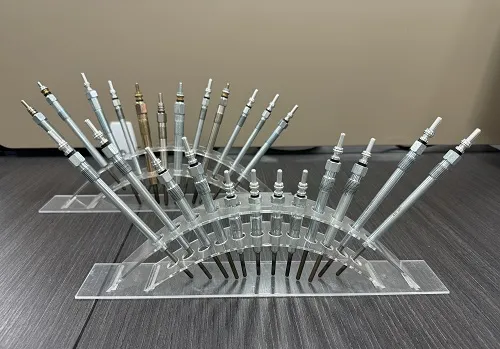
A metal rod glow plug contains a heating coil inside a heat-resistant metal tube. Magnesium oxide surrounds the coil, helping protect it from vibration and shock while transferring heat from the coil to the outer glow tube.
Several metal glow plug designs are available, including:
Standard metal rod glow plugs
Quick-start glow plugs
Self-regulating metal glow plugs
Advanced Quick Glow System, or AQGS, plugs
In a self-regulating design, the regulating coil increases its electrical resistance as the temperature rises. This reduces current flow and helps control the temperature without allowing the heating element to overheat.
Metal glow plugs remain widely used because the technology can be adapted to many diesel-engine platforms. Advanced metal designs can also provide fast warm-up performance, so buyers should not assume that every ceramic plug is automatically faster than every metal plug.
A ceramic glow plug uses a ceramic heating element or surrounds its heating element with a high-performance ceramic material, commonly silicon nitride. This material provides strong thermal conductivity and allows the heating element to operate at very high temperatures.
High-temperature ceramic glow plugs are particularly suitable for engines that require:
Very short pre-glow periods
High peak temperatures
Extended post-glow operation
Stable cold combustion in low-compression diesel engines
Support for emissions-control functions
Published manufacturer data illustrate the potential performance of this technology. NGK states that its NHTC ceramic glow plugs can reach 1,000°C in less than two seconds and continue after-glowing for more than ten minutes at temperatures of up to 1,350°C. Bosch lists a typical heat-up time of 1.4 seconds to 1,000°C, a maximum temperature of 1,350°C, and a nominal voltage of 7 V for one of its ceramic low-voltage designs. These figures are product-specific benchmarks rather than universal specifications for every ceramic plug.
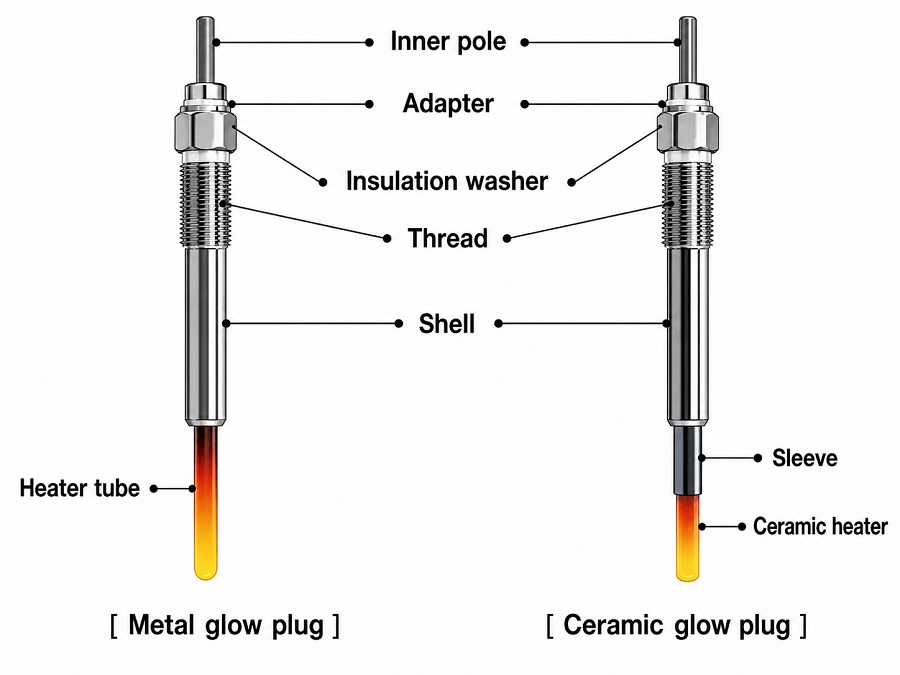
| Comparison Factor | Metal Glow Plug | Ceramic Glow Plug | What Buyers Should Consider |
| Heating element | Metal heating coil inside a heat-resistant metal tube | Ceramic heating element or heating element protected by high-performance ceramic | Construction must match the engine and control system |
| Heat-up speed | Varies from conventional to advanced quick-glow designs | Usually designed for very rapid heating | Compare the exact time-to-temperature specification |
| Operating temperature | Suitable for a wide range of conventional and modern diesel applications | Can support extremely high temperatures, with some designs reaching 1,350°C | Higher temperature is useful only when required by the engine |
| Post-glow capability | Available, depending on the design and controller | Frequently optimized for long post-glow and intermediate-glow cycles | Check the ECU and glow control unit strategy |
| Temperature regulation | May use a separate regulating coil | Can use self-regulating or fully ceramic technology | Electrical characteristics must match the original system |
| Application range | Common across many established diesel platforms | Common in advanced low-voltage and emissions-focused applications | Confirm the OE number, engine code, and vehicle application |
| Typical commercial position | Often suitable for cost-sensitive, established applications | Often positioned for demanding cold-start and emissions requirements | Compare total value, not only unit price |
| Replacement suitability | Correct when specified by the vehicle manufacturer | Correct when specified by the vehicle manufacturer | Do not upgrade based on material alone |
Metal glow plugs are usually the appropriate choice when the original diesel engine was designed around a metal rod system and the replacement part matches the required dimensions and electrical specifications.
They are particularly suitable for buyers sourcing parts for:
Established passenger-car diesel engines
Light commercial vehicle applications
Repair markets that prioritize broad compatibility
Fleets requiring predictable replacement costs
Engines using standard, self-regulating, or quick-glow metal technology
A modern metal plug should not be viewed as an outdated product by definition. DENSO has previously replaced two ceramic aftermarket references with metal double-coil equivalents without changing the listed vehicle applications or cross-references. This example demonstrates that the validated replacement specification matters more than the material label alone.
For brand-specific purchasing, a buyer sourcing a bmw glow plug should provide the vehicle model, engine code, production year, OE reference, and required voltage. BMW diesel engines across different generations may use different glow plug and control-unit configurations, even when the plugs appear physically similar.
Ceramic glow plugs are generally selected for diesel engines that require very fast heat-up, high thermal output, or prolonged heating after startup.
They may be the better choice when:
The engine was originally fitted with ceramic glow plugs
The diesel platform has a relatively low compression ratio
Cold-start performance is especially demanding
The ECU uses extended post-glow or intermediate-glow strategies
The glow system supports exhaust-emissions management
Installation space requires a compact heating tip
Ceramic technology can provide significant thermal performance, but buyers should not install a ceramic plug simply because it reaches a higher temperature. The glow control unit must supply the correct voltage and current profile. An incompatible plug may heat incorrectly, fail prematurely, or create problems elsewhere in the glow system.
When purchasing an audi glow plug, for example, importers should identify the exact diesel engine and OE number rather than relying only on the vehicle brand or model name. Audi applications may differ by engine displacement, engine generation, market, and emissions configuration.
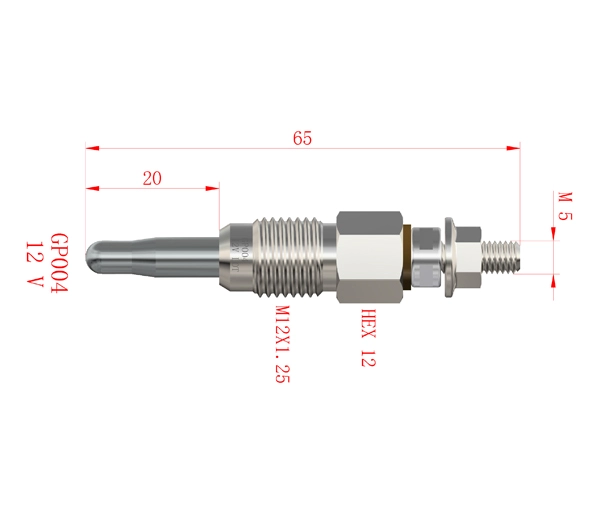
The most important purchasing principle is that a glow plug is an electronically controlled engine component, not a universal heating rod.
Two plugs may have the same thread diameter and similar overall length but still differ in:
Nominal voltage
Heating resistance
Heat-up curve
Maximum temperature
Terminal design
Installation depth
Heating-tip projection
Control-unit compatibility
Bosch aftermarket catalogues, for example, include glow plugs with different voltage specifications, including 7 V and 11 V products. Supplying a plug with the wrong voltage can produce an incorrect heating rate or cause early failure. DENSO reports that excessive voltage and excessive heat are among the most common causes of glow plug failure.
Buyers should therefore cross-reference at least one reliable identifier:
Original Equipment part number
Engine code
Vehicle identification number
Glow plug manufacturer reference
Vehicle make, model, year, and engine displacement
For bulk orders, using two or more identifiers substantially reduces the risk of application errors.
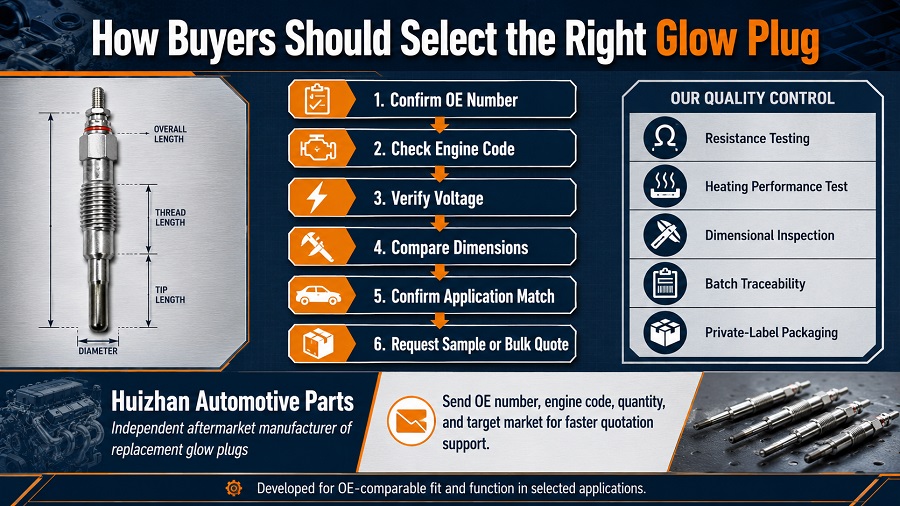
The OE reference should be the starting point for every quotation. A supplier should confirm whether the offered product is a direct replacement or an alternative validated for the same application.
Do not assume that every passenger-car glow plug is a conventional 12 V component. Modern electronically controlled systems may use lower-voltage plugs operated through a glow control module.
Confirm the thread diameter, pitch, overall length, hex size, heating-tube length, and terminal type. A small dimensional difference can change the plug’s position relative to the fuel spray.
Ask for heat-up time, target temperature, current curve, and post-glow capability where available. These values provide more useful information than the words “metal” or “ceramic” alone.
The glow plug and glow control unit operate as a system. Buyers should investigate the control unit whenever several glow plugs show similar heat damage or premature failure.
For aftermarket distribution, buyers should request details about dimensional inspection, electrical resistance testing, heating tests, insulation checks, and application validation.
Each unit or set should be identifiable by part number, batch information, and application data. Clear labeling reduces warehouse picking errors and makes quality claims easier to investigate.
One common mistake is ordering entirely by vehicle brand. A Mercedes-Benz vehicle range, for example, may contain multiple diesel engines with different glow plug dimensions, voltages, and heating strategies. Buyers examining a mercedes glow plug should always confirm the engine code and OE reference before approving a bulk order.
A second mistake is marketing ceramic plugs as universal upgrades for metal plugs. Unless a replacement has been specifically validated for the application, changing materials can alter the electrical and thermal behavior of the system.
A third mistake is focusing only on purchase price. A low-cost plug that produces incorrect resistance readings, inconsistent heat-up times, or application returns can create greater costs through warranty claims, repeated labor, and customer dissatisfaction.
Finally, buyers should not assume that every glow plug failure is caused by the plug itself. Injector problems, carbon deposits, an incorrect control signal, overvoltage, or unsuitable installation torque may damage an otherwise correctly manufactured component.
Huizhan is an independent aftermarket automotive-parts manufacturer specializing in diesel engine components, including glow plugs, oil pumps, vacuum pumps, camshafts, and camshaft phasers. Since 2018, Huizhan has combined automotive parts manufacturing experience with product development capabilities to support global distributors, wholesalers, and aftermarket customers.
With support for OE reference matching, sample verification, OEM/ODM production, and private-label solutions, Huizhan helps buyers develop reliable glow plug products for different diesel applications. The company’s manufacturing capabilities support stable supply, with a reported monthly production capacity exceeding 100,000 pieces across its engine-parts range.
No. Ceramic glow plugs can reach higher temperatures and may heat more rapidly, but those advantages matter only when the engine and glow control unit are designed for that technology. A correctly specified metal glow plug is better than an incompatible ceramic plug.
Only when the replacement manufacturer or vehicle manufacturer has validated the ceramic plug for the same OE application. Similar dimensions do not guarantee compatible voltage, resistance, or heating behavior.
The exact temperature depends on the product. Bosch and NGK publish maximum figures of up to 1,350°C for specific high-temperature ceramic designs. These values should not be applied to every ceramic glow plug.
Service life depends on the plug design, driving conditions, engine condition, control voltage, and installation quality. Niterra provides an average estimate of approximately 160,000 kilometers but notes that plugs may fail earlier because of component quality or engine-related problems.
Replacing the complete set is often advisable when the plugs have similar mileage and operating history. It can reduce repeated labor and vehicle downtime. However, technicians should also test the control unit and investigate the cause of any abnormal plug damage.
Provide the OE number, engine code, vehicle make and model, production year, voltage specification, required quantity, target market, and packaging requirements. Photos and dimensions of the original sample can provide additional confirmation when the OE number is unavailable.
Metal and ceramic glow plugs serve the same basic purpose, but they achieve the required heating performance through different materials and designs. Ceramic plugs are well suited to engines requiring extremely fast warm-up, high temperatures, and extended post-glow operation. Metal plugs remain the correct and commercially practical solution for many established and modern diesel applications.
For buyers, the correct decision should always be based on the OE reference, engine code, voltage, dimensions, heating characteristics, and glow control strategy—not on material alone.
Huizhan supports distributors and aftermarket buyers with OE-number matching, sample confirmation, bulk quotations, and private-label manufacturing for selected diesel-engine applications. Send the original part reference, engine code, and purchasing requirements to confirm the appropriate aftermarket car glow plug. Send the original part number and purchasing requirements to confirm the appropriate metal or ceramic car glow plug for your target market.

 English