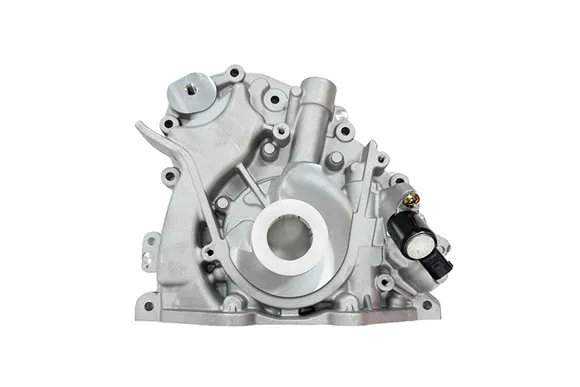
A hard brake pedal, oil around the vacuum pump, unusual mechanical noise or a vacuum-related engine fault can lead a technician to suspect BMW vacuum pump failure. None of these symptoms confirm the pump itself is defective.
Treat the vacuum system as a full circuit, not a single part. Depending on the engine, that circuit can include the vacuum pump, brake booster, non-return valves, vacuum reservoir, hoses and additional pneumatic actuators.
BMW has used very different vacuum architectures across engine families, and that's what makes a single diagnostic checklist unreliable. The N55 uses a two-stage vacuum pump, with one stage supplying the brake booster and the other supplying auxiliary consumers. The S55 dropped to a single-stage pump with one connection for the brake booster, because BMW electrified the pneumatic functions that the N55 still ran off vacuum. The N57TU diesel is different again: its vacuum system also operates engine mounts and EGR-related components.
So before ordering a replacement pump, diagnosis needs to establish three things: whether the pump produces the required vacuum, whether that vacuum reaches the brake booster and other consumers, and whether engine oil has entered the vacuum circuit.
The brake booster needs a pressure difference to reduce the pedal force required from the driver. On some engines, intake manifold vacuum alone can't supply that consistently.
BMW's N62 documentation is a good example of why. Because the throttle can stay open while the car is being driven, the engine needs extra vacuum for the brake booster. The N62 pump also has a second connection for exhaust-flap adjustment.
Valvetronic gets brought up a lot in these discussions, but it's only part of it. Diesel architecture, turbo-control strategy and the number of pneumatic consumers on a given engine all change what the system actually needs.
BMW Engine Example | Vacuum Pump / System Configuration | Main Vacuum Consumers | What It Means for Diagnosis |
N62 | Mechanical pump with an additional vacuum connection | Brake booster, exhaust flap | Low vacuum can affect more than brake assistance |
N55 | Two-stage vacuum pump | Stage 1: brake booster; Stage 2: auxiliary consumers | Brake-booster vacuum and auxiliary vacuum should not automatically be treated as the same circuit |
S55 | Single-stage pump, one vacuum connection | Brake booster | Pneumatic functions used on the N55 were largely electrified |
N57TU diesel | Pump feeding a wider vacuum network | Brake booster, EGR bypass vacuum unit, engine-mount vacuum unit and related controls | Engine-performance symptoms may require circuit-by-circuit diagnosis |
A turbocharged BMW might run a vacuum-operated wastegate, an electric wastegate, or a vacuum system that only touches the brake booster. Check the engine code before assuming anything about which one you're dealing with.
A hard brake pedal is one of the more safety-relevant complaints tied to a vacuum-system fault.
The brake booster reduces how much force the driver has to apply. If available vacuum drops, booster assistance drops with it, and the driver may suddenly need much more pedal force to get the same result.
That doesn't mean the hydraulic brakes have failed outright.
BMW made this distinction explicitly in its owner notification for Recall 10V-446: if power brake assist were lost, the service brake would still slow and stop the vehicle, but the driver would need to apply greater pedal force. BMW also told affected owners not to keep driving if they noticed decreased power brake assist.
BMW brake-system training material notes that after the engine stops, a brake booster may hold onto enough vacuum for roughly two or three pedal applications before the pedal goes hard. That's useful for understanding how a booster behaves, but it isn't a pass/fail spec you can apply to every BMW model.
So a change in brake feel needs to be diagnosed right away. The real question isn't "is the vacuum pump bad?" It's "why isn't the booster getting enough vacuum?"
The cause could be pump output, a leaking hose, a failed non-return valve, poor vacuum retention or a booster fault itself.
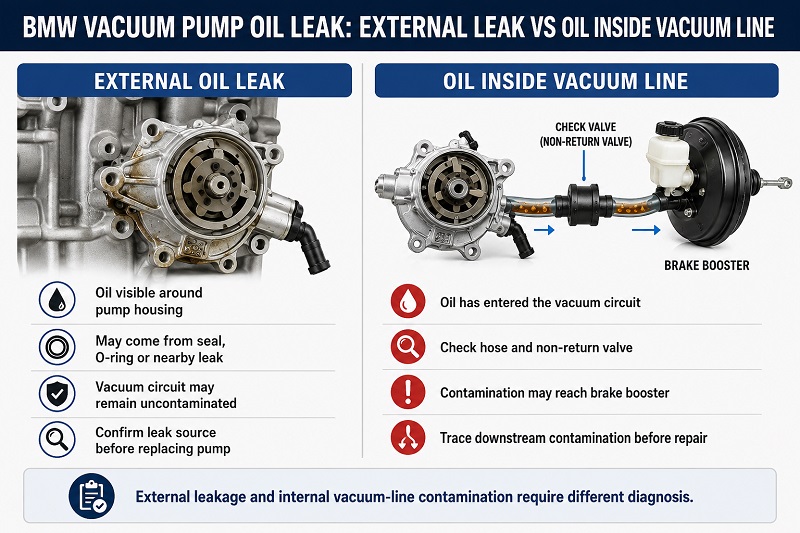
Oil around a BMW vacuum pump can mean two very different things.
An external leak is oil visible around the outside of the pump or its mounting area.
It can come from the pump-to-cylinder-head seal, an O-ring, a housing joint, or a leak elsewhere above the pump that has just run down onto it. Oil spreads across surrounding components easily, so the wettest-looking spot isn't always where it started.
If the pump still produces the specified vacuum and the issue is limited to a serviceable mounting seal, replacing the whole pump usually isn't necessary.
Oil inside the vacuum hose is a different problem, because now the contamination is inside the circuit itself.
BMW's own recall history backs this up. NHTSA Campaign 10V-446 covered 198,352 BMW vehicles in which lubricating oil could pass from the brake vacuum pump into the vacuum hose and eventually reach the brake booster. That contamination could reduce power brake assistance, and in extreme cases cause a complete loss of power assist.
BMW's related service information states that oil entering the brake-booster vacuum supply line could damage the booster membrane and cause vacuum leakage.
Condition | External Oil Around Pump | Oil Inside Vacuum Line |
Where oil is found | Pump housing, mounting surface or surrounding engine area | Inside hose, check valve or downstream vacuum circuit |
Does it confirm internal pump failure? | No | Indicates oil has entered the vacuum circuit; source still needs confirmation |
Main concern | Engine oil leakage and sealing condition | Vacuum-system contamination and possible downstream component damage |
Brake-booster impact | Usually indirect unless vacuum is also leaking | Oil may migrate toward and contaminate the booster |
Repair approach | Identify leak source; inspect seal and pump condition | Trace contamination, inspect hose/check valve/booster and correct the source |
Is pump replacement always required? | No | Depends on where contamination originated and pump condition |
Sort this out before ordering parts. Replace a wet pump without checking whether the leak is only external, and you've likely wasted a part. Replace the pump but skip the downstream check, and contaminated components stay in the car.
Clicking, scraping or grinding can point to mechanical pump wear, but noise alone doesn't prove much on its own. It needs to be localized and checked against actual pump performance.
Vacuum-related engine faults have to be read through the lens of the specific engine, too. The N55 pairs its two-stage pump with a vacuum-operated, electronically controlled wastegate, so a fault in the auxiliary circuit can affect turbo control without showing up at the brake booster at all.
The S55 makes the point well: BMW moved it to a single-stage pump feeding only the brake booster, while wastegate valves and exhaust flaps became electrically operated. Whatever worked for diagnosing an N55 doesn't automatically transfer.
A fault code, weak boost response or odd engine behavior is a lead worth following, not proof the pump needs replacing.
Vacuum-pump diagnosis comes down to finding exactly where generation or retention is failing.1. Identify the Engine Before Applying a Vacuum Specification
Start with the model, production date and engine code.
There's no single vacuum pressure figure that applies across every BMW vacuum pump. On the S85, for instance, BMW's supplemental electric vacuum pump switches on around -250 mbar and off around -600 mbar. Those numbers describe that specific electronically controlled system, not a general replacement threshold.
For an actual repair, compare measured values against BMW repair information for that exact engine and circuit.
Pedal feel is a useful starting point, but it shouldn't replace an actual pressure measurement.
If the pedal gets noticeably harder than normal, especially after the first few applications, look into insufficient booster vacuum or poor retention.
BMW's brake training procedure has you release stored vacuum with the engine off, then watch how pedal feel changes once the engine starts. A working system shows a clear change in assist as vacuum builds back up.
If assistance has dropped unexpectedly, treat it as a safety issue rather than continuing to road-test.
Start with the pump mounting area and the full hose route to the booster.
A cracked hose, loose fitting or bad non-return valve can starve the booster of vacuum even when the pump itself is fine. Check both the outside and inside of accessible vacuum connections for oil while you're at it.
Oil outside the pump points you toward a sealing investigation. Oil inside the line means downstream contamination is now part of the diagnosis.
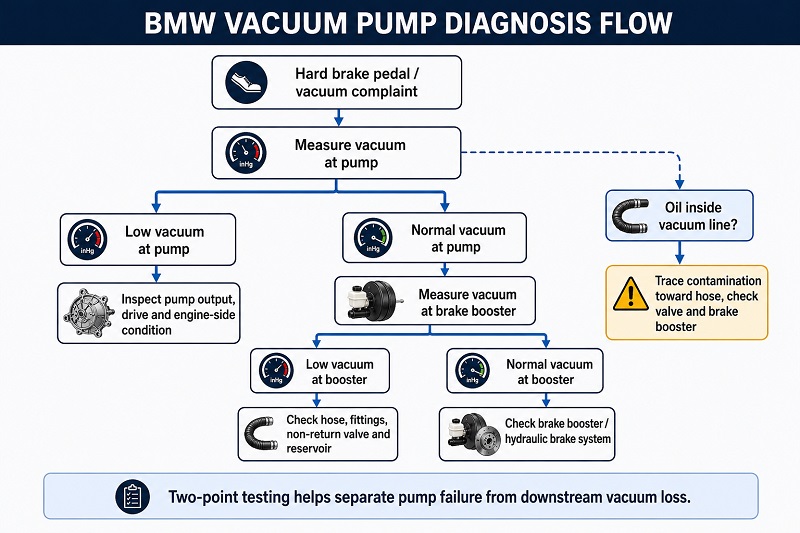
This answers the first real question: can the pump generate the required vacuum?
A low reading right at the pump outlet puts the pump, its drive, or engine-side operating conditions on the suspect list.
A normal reading there changes the direction entirely — move downstream instead of reaching for a replacement pump.
A second reading closer to the booster can reveal vacuum loss happening between the pump and the booster.
Diagnostic Observation | More Likely Direction | What to Check Next |
Vacuum below specification directly at pump | Pump output or drive problem | Pump condition, drive interface, engine-specific pump operation |
Normal at pump but low at booster | Vacuum loss downstream | Hose, fittings, non-return valve, reservoir |
Vacuum reaches booster but assist remains poor | Booster or brake-system issue | Booster integrity and hydraulic brake system |
Vacuum falls too quickly after supply stops | Retention problem | Check valve, hose leakage, booster diaphragm |
Oil present inside vacuum line | Internal contamination path | Pump/check valve source and how far oil has travelled |
Brake vacuum normal but engine actuator fault remains | Auxiliary circuit problem | Solenoid, actuator, reservoir or engine-specific vacuum branch |
Two readings tell you far more than one reading followed by an immediate pump swap.
Generating vacuum and holding onto it are two different things.
A pump can hit the expected pressure while running and still lose it fast once the supply cuts off, if a check valve or the booster itself is leaking. If the complaint mostly shows up after the car has been parked, or after repeated brake applications, retention testing is where to look.
BMW-compatible diagnostic tools can flag faults tied to vacuum-operated components, but fault memory needs to be read alongside physical testing, not instead of it.
On engines with auxiliary vacuum consumers, actuator tests and live data can narrow the fault down to a specific branch.
If pump output and booster vacuum both check out normal, replacing the pump over an unrelated turbo or EGR fault isn't a defensible call.
Replacement makes sense once testing points at the pump itself rather than the rest of the system.
Output measured below spec is one of the stronger reasons, as long as downstream leakage has been ruled out. Confirmed internal mechanical damage, a cracked housing, or oil carrying over from the pump into the vacuum circuit also supports replacement.
An external oil leak is more of a judgment call. If it's coming from a serviceable gasket or mounting seal and pump output is still correct, a sealing repair may be all that's needed.
A leaking component and a failed component aren't the same thing, and that distinction matters for both workshops and parts buyers.
Once diagnosis supports a replacement, the job should cover the surrounding vacuum system, not just the pump itself.
OE number is still the strongest reference, but pair it with engine code and production date.
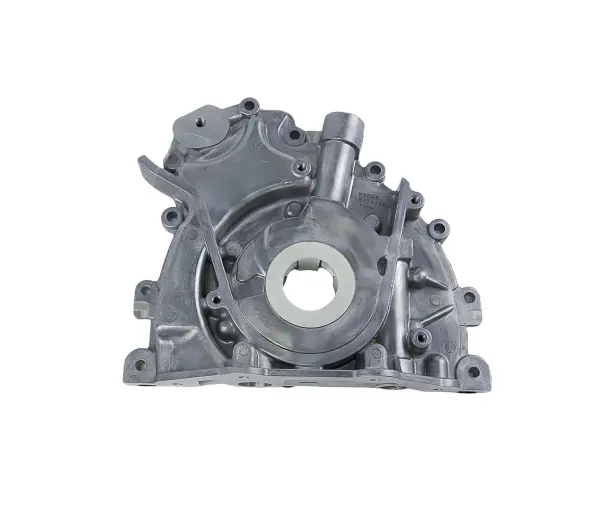
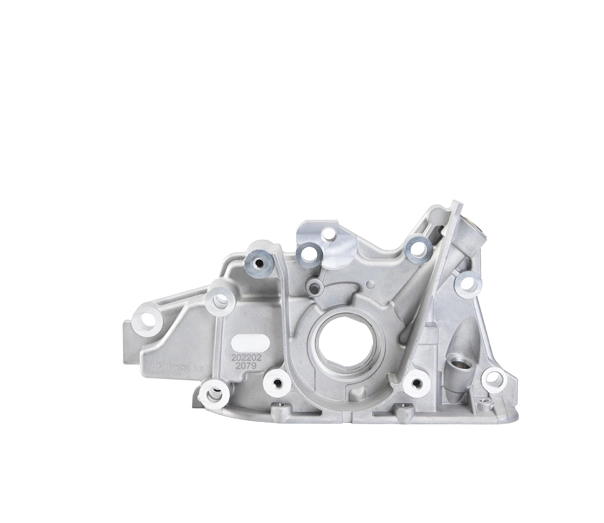
Two pumps can look nearly identical and still differ in drive interface, mounting, port orientation or internal configuration. The N55 and S55 are a good example of how much BMW can change the vacuum architecture even between related performance engines.
If the application is uncertain, have the supplier compare the original pump physically instead of matching by vehicle-series name alone.
After removal, check the mounting surface, gasket or O-ring arrangement and drive interface.
Old sealing material, damaged mating surfaces or leftover contamination can cause a fresh leak even when the new pump is working fine. Get the correct gasket setup and tightening procedure from the repair information for that specific engine.
Pay particular attention to the vacuum hose and non-return valve — a new pump won't fix a downstream leak.
If the engine has auxiliary vacuum consumers, check their hoses, valves and reservoirs too if they were part of the original complaint.
If oil has gotten into the line, figure out how far it's traveled before calling the job done.
BMW's 10V-446 repair history shows why. On vehicles where contamination reached the brake booster, the fix went beyond the supply line; contaminated booster components needed additional work. That recall applies to specific vehicles, not every BMW, but it's solid evidence that internal contamination and an external leak aren't equivalent problems and shouldn't be repaired the same way.
Post-repair verification should repeat the checks that found the fault in the first place.
Vacuum output should meet spec for the engine, the booster should receive and hold vacuum, brake assistance should feel normal again, and any sealing areas that were repaired should stay dry.
Clear diagnostic faults where appropriate and recheck the system after the car has been driven. Where the pump also feeds auxiliary consumers, confirm those work too — restored brake assist doesn't mean the whole vacuum circuit is fine.
There's no single replacement-cost figure that applies across all BMW vacuum pumps, because labor access, engine configuration and collateral damage vary a lot.
A simple pump-and-seal job looks nothing like a repair involving contaminated vacuum lines, a non-return valve or a brake booster.
BMW's recall documentation shows the range: replacing the brake vacuum line could take up to 2.5 hours, while a repair involving the brake booster and master cylinder could run up to 5 hours. Those numbers are specific to that recall procedure, not a universal labor guide, but they show how much oil contamination downstream can change the scope of a job.
For current repairs, quote the pump separately from diagnosis, seals, vacuum lines, valves, booster work and engine-specific labor.
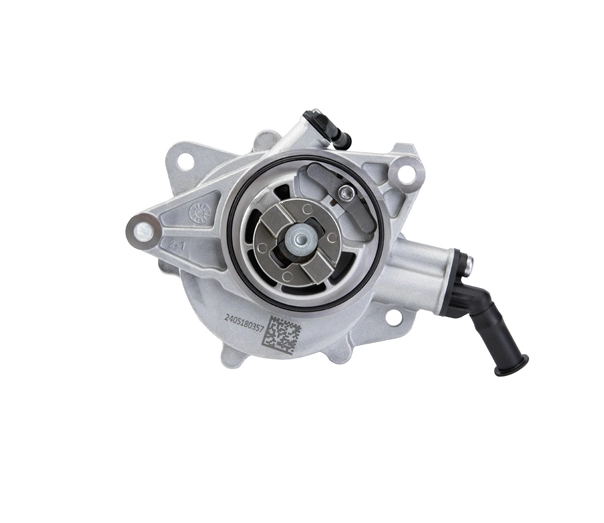
For aftermarket buyers, start with application confirmation, not price.
The most useful identifier is the OE reference from the removed component, followed by engine code, production period and physical pump configuration.
Purchasing Check | Why It Matters | What the Buyer Should Confirm |
OE reference | Reduces incorrect cross-application | Original OE number and any verified supersession |
Engine code | Separates different vacuum architectures | Exact engine family rather than only vehicle model |
Production date | BMW may change components within one model generation | Month/year or VIN-based application |
Drive interface | Incorrect geometry prevents proper operation | Compare original and replacement |
Vacuum connections | Port number and orientation may differ | Photos and physical dimensions |
Sealing components | Incorrect sealing can create an immediate oil leak | Gasket/O-ring inclusion and specification |
Vacuum performance | Physical fit alone does not confirm pump performance | Supplier's functional or vacuum-output test method |
Sample verification | Reduces risk before large-volume purchasing | Sample or first-article comparison before bulk order |
Traceability | Useful for aftermarket quality control | Batch identification and repeat-order consistency |
Huizhan supplies aftermarket replacement vacuum pumps for selected BMW applications. As one of the experienced vacuum pumps suppliers serving the automotive aftermarket, Huizhan provides replacement solutions for bulk sourcing and distribution. These products are not BMW Genuine parts, and Huizhan is not the original component manufacturer.
The parts are made to OE-standard quality and application requirements, intended to match fit, function and performance of the original component when the correct part number and engine application are selected.
For BMW vacuum-pump sourcing, buyers can send the OE number, engine code, production information and photos of the original component for application verification before placing a bulk order.
For related product information, see BMW Vacuum Pumps, Car Vacuum Pumps and BMW Car Parts.
Yes. Insufficient vacuum reduces brake-booster assistance and can substantially increase the pedal force needed.
That doesn't mean the hydraulic brakes have failed. BMW's documentation for Recall 10V-446 specifically states the service brake could still slow and stop the vehicle after a loss of power assist, though it would take more pedal force.
Treat an unexpected drop in brake assistance as a safety issue and diagnose it before driving normally again.
No. An external oil leak may come from the mounting seal or a nearby engine component instead of the pump itself.
Locate the source and test vacuum output before writing off the whole pump.
Oil found inside the vacuum line is a different situation, because the circuit itself is now contaminated and downstream components may need inspection.
Yes, on at least some documented BMW applications.
NHTSA Recall 10V-446 covered 198,352 vehicles where lubricating oil could enter the brake vacuum hose and contaminate the booster. BMW's service information states the contamination could damage the booster membrane and reduce or eliminate power brake assistance.
That doesn't mean every vacuum pump leak on every BMW will contaminate the booster. Check the specific vacuum architecture and where the oil actually is before assuming the worst.
There's no single number that applies to every BMW engine.
On the S85, for example, BMW's auxiliary electric vacuum pump switches on around -250 mbar and off around -600 mbar. Those figures describe the S85's control strategy specifically, not a universal spec.
Use the repair information for the exact model and engine being tested.
It depends on the engine.
The N55 uses a two-stage vacuum pump and a vacuum-operated wastegate, so a vacuum fault can affect the auxiliary side of the system. The S55 moved to electric wastegates and a single-stage pump that only serves the brake booster.
Establish the engine code before linking a turbocharger complaint to the vacuum pump.
Before replacement, diagnosis needs to answer four questions: Is pump output below spec? Is vacuum being lost somewhere downstream? Is oil only leaking externally, or has it gotten into the vacuum line? Is the replacement pump confirmed for the exact engine and production period?
If the pump is confirmed defective, check the sealing surface, non-return valve, vacuum line and relevant downstream components before installing the replacement. If contamination shows up inside the vacuum circuit, trace it toward the booster instead of treating the job as a pump-only swap.
For aftermarket ordering, use the OE number as the primary reference, then confirm it against engine code, production information, pump housing, drive interface and vacuum connections.
That combination cuts down on both unnecessary replacement during diagnosis and mismatched parts during purchasing.

 English