A rough idle, hesitation, a check engine light or a timing-related fault code will often put the variable timing solenoid at the top of the suspect list. It shouldn't be the first thing replaced.
Variable valve timing is hydraulic, electrical and mechanical at once. The ECU commands a timing change, the VVT solenoid regulates engine-oil flow, and the camshaft phaser uses that oil pressure to move the camshaft toward the requested position. Camshaft and crankshaft sensors then tell the ECU whether the commanded change actually happened.
A fault anywhere in that chain produces similar drivability symptoms. Dirty oil can restrict the solenoid. Low oil pressure can stop the phaser from moving even when the solenoid gets the right electrical command. A worn phaser responds slowly. Timing-chain wear shifts mechanical correlation. A wiring fault can stop the solenoid from being commanded at all.
So instead of asking "is the VVT solenoid bad," a better starting question is where in the chain the fault sits: electrical command, hydraulic oil control, camshaft actuator, mechanical timing, or feedback signal.
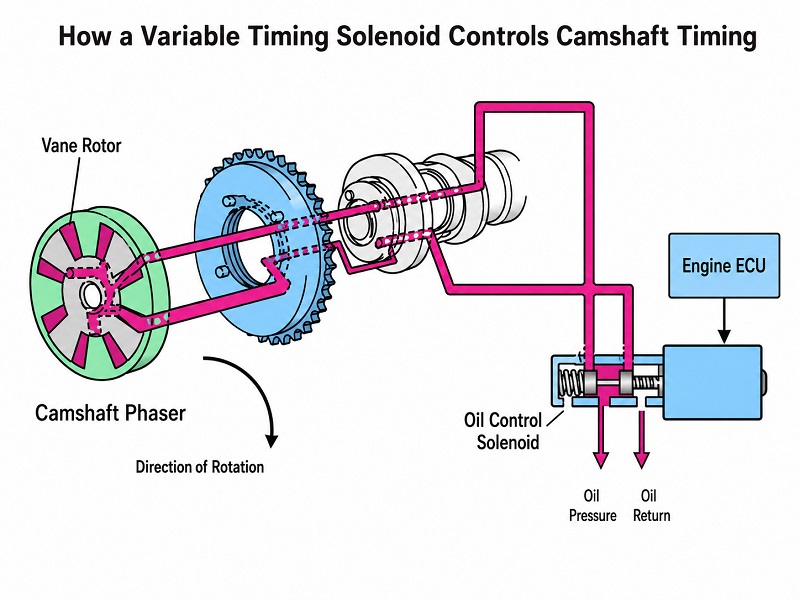
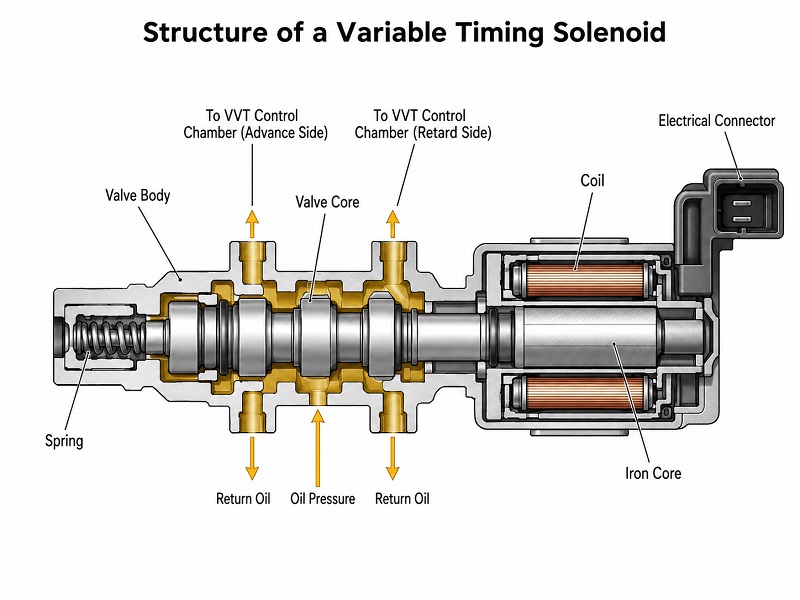
A variable timing solenoid — also called a VVT solenoid, oil control valve (OCV), camshaft position actuator solenoid or cam timing control valve — regulates oil flow to the camshaft phaser.
The ECU calculates a desired camshaft position from engine speed, load and temperature, then adjusts the solenoid command so pressurized oil routes into or out of the phaser's advance and retard chambers. The chain worth tracking during diagnosis: ECU command, VVT solenoid oil control, camshaft phaser movement, actual camshaft position feedback.
Most capable scan tools will show both desired and actual camshaft position. Kia's technical training recommends comparing the two directly when evaluating CVVT performance: actual position should track the ECU's desired position closely during operation. That comparison tells you far more than a check-engine light on its own.
A VVT solenoid can fail electrically, get restricted hydraulically, or develop a mechanically sticking spool. If it can't route oil correctly, the phaser ends up too far advanced, too far retarded, or slow to respond — and the effect shows up differently depending on how the engine is running.
At idle, incorrect cam timing can hurt combustion stability and cause rough running. Under load, the engine may not reach the valve timing needed for efficient cylinder filling, which shows up as weak acceleration or hesitation.
Fuel economy can drop too, though not because of "longer combustion cycles" — that's not really how it works. Variable valve timing manages valve events, charge motion, volumetric efficiency, pumping losses and combustion conditions. When actual timing doesn't track commanded timing, the engine runs outside the strategy calibrated for that load and speed, and it may need more fuel to hit the requested output. This is well documented — manufacturers routinely tie VVT directly to fuel-efficiency and emissions targets.
Starting problems can happen for the same reason. If camshaft position is off during cranking or right after startup, valve events won't match what the ECU expects for a cold start. But hard starting by itself doesn't point at the solenoid — mechanical timing, phaser condition, oil pressure and sensor correlation all need to be checked too.
These four codes get lumped together in VVT discussions, but they’re not the same kind of fault, and knowing the difference is one of the easiest ways to avoid replacing a solenoid that didn't need it.
DTC | General Meaning | What the Code Is Telling You | Areas That Deserve Investigation |
P0010 | "A" Camshaft Position Actuator Circuit/Open, Bank 1 | Primarily an electrical-control circuit fault | Solenoid coil, connector, wiring, power supply, ECU control circuit |
P0011 | "A" Camshaft Position Timing Over-Advanced or System Performance, Bank 1 | Actual cam timing is too advanced or the system isn't responding as expected | Sticking solenoid, contaminated oil, oil pressure, phaser, mechanical timing, calibration/software |
P0014 | "B" Camshaft Position Timing Over-Advanced or System Performance, Bank 1 | Similar performance fault affecting the "B" camshaft | Oil control, solenoid response, phaser, oil pressure, mechanical timing |
P0016 | Crankshaft Position–Camshaft Position Correlation, Bank 1 Sensor A | Camshaft and crankshaft positions are outside the expected relationship | Timing-chain alignment/wear, phaser position, sensor/reluctor problem, oil-controlled timing fault |
On many DOHC engines "A" refers to the intake camshaft and "B" to the exhaust camshaft, but confirm the manufacturer's terminology for the specific engine before assuming.
P0010 points to the actuator circuit, not camshaft performance. An open circuit, damaged harness, poor connector contact, bad solenoid coil or ECU driver issue can all keep the oil-control valve from getting a command in the first place.
If P0010 is present, replacing a mechanically healthy phaser because the camshaft isn't moving skips right past the actual problem.
Electrical thresholds vary a lot by manufacturer. Audi/VW publish model-specific values for P0010 rather than one universal number, which is why a claim like "a good VVT solenoid should measure X ohms" doesn't hold across different vehicles.
P0011 means the Bank 1 "A" camshaft is more advanced than expected, or the cam timing system isn't performing within its calibrated range.
A sticking oil-control valve can cause it — Volkswagen has documented P0011 alongside P0016 on certain diesel applications where the camshaft adjuster control valve could stick. But Subaru's diagnostic procedures for the same family of codes start with oil condition, timing-chain position, wiring and oil pressure, not the valve. General Motors has also documented cases where camshaft performance codes traced back to ECM synchronization behavior rather than a defective oil-control valve or phaser. So the code by itself doesn't tell you which of those it is.
P0014 is the same kind of code as P0011 but for the "B" camshaft on Bank 1. On engines where "B" is the exhaust camshaft, the diagnosis needs to focus there: does the ECU command reach the correct exhaust solenoid, can that solenoid route oil correctly, does actual exhaust-cam position follow desired position, and can the exhaust phaser mechanically return to where it should be.
GM has documented rough running, hesitation, hard starting and stalling alongside P0011/P0014 on specific applications where camshaft actuator solenoids were confirmed at fault — but that's evidence for those applications, not a green light to replace every P0014 solenoid untested.
P0016 gets special treatment here because it's a crankshaft-to-camshaft correlation code, not a VVT-solenoid-specific one.
If that relationship is wrong, there are several separate possibilities to rule out: a worn or mispositioned timing chain, a mechanically stuck phaser, oil pressure that won't let the phaser return, an inaccurate camshaft or crankshaft sensor signal, a shifted reluctor or trigger wheel. A VVT oil-control problem is only one branch of that list.
Subaru's current BRZ procedure for P0016–P0019 shows the logic well: it checks VVT data, oil condition, timing-chain position, wiring resistance and oil pressure before landing on which part actually needs repair.
Rather than treating each complaint as its own symptom, it helps to connect the behavior to what the engine camshaft is actually doing.
At idle, the ECU expects the camshafts to sit in a controlled position that supports stable combustion — restricted oil flow or a phaser sitting off-target can show up as fluctuating RPM. During acceleration, the target cam angle changes; a sticking solenoid or restricted oil passage can make actual position lag behind the target, which feels like hesitation.
Cold starting adds another variable, since oil viscosity and pressure differ from a fully warmed engine. A complaint that only shows up after a long cold soak needs a different read than one that happens continuously at operating temperature. This is also where freeze-frame data earns its keep — engine speed, oil temperature, coolant temperature and load at the moment the fault stored can separate a cold-start hydraulic issue from an electrical fault that happens regardless of temperature.
It can be associated with timing-area noise, but don't pin noise on the solenoid without more diagnosis.
A sticking solenoid can interfere with oil flow to the phaser and delay hydraulic control after startup. That said, a rattle or ticking noise can just as easily come from the phaser itself, the timing chain, the chain tensioner, or inadequate oil pressure.
Ford's cam-phaser service documentation identifies a cold-start rattle on specific 3.5L EcoBoost applications, and similar noise on some units has also shown up at warm idle when oil pressure is marginal. Mazda has published procedures that link timing-cover and cylinder-head rattle to VVT actuator and timing-chain inspection together, rather than defaulting to the solenoid.
Noise is only useful evidence when it's read alongside oil pressure, commanded-vs-actual camshaft movement, and mechanical timing condition.
This table is more useful than matching one symptom to one part.
Diagnostic Evidence | VVT Solenoid | Camshaft Phaser | Timing Chain / Mechanical Timing | Sensor / Wiring |
Actuator-circuit code such as P0010 | High | Low | Low | High |
Correct electrical command but cam angle doesn't respond | Medium–High | High | Medium | Low |
Solenoid spool physically sticks | High | Low | Low | Low |
Actual cam position responds slowly with dirty/sludged oil | High | Medium | Low–Medium | Low |
Cold-start rattle or hot-idle phaser knock | Low–Medium | High | High | Low |
P0016 crank/cam correlation code | Medium | Medium–High | High | Medium–High |
Mechanical timing marks incorrect | Low | Medium | Very High | Low |
Low engine oil pressure | Solenoid may be functional | Phaser can't be controlled correctly | May affect tensioner/timing system | Low |
Open circuit or damaged connector | Electrical control can't operate | Low | Low | Very High |
Actual and desired angles match normally | Solenoid less likely | Phaser less likely | May still need separate check | Investigate other systems |
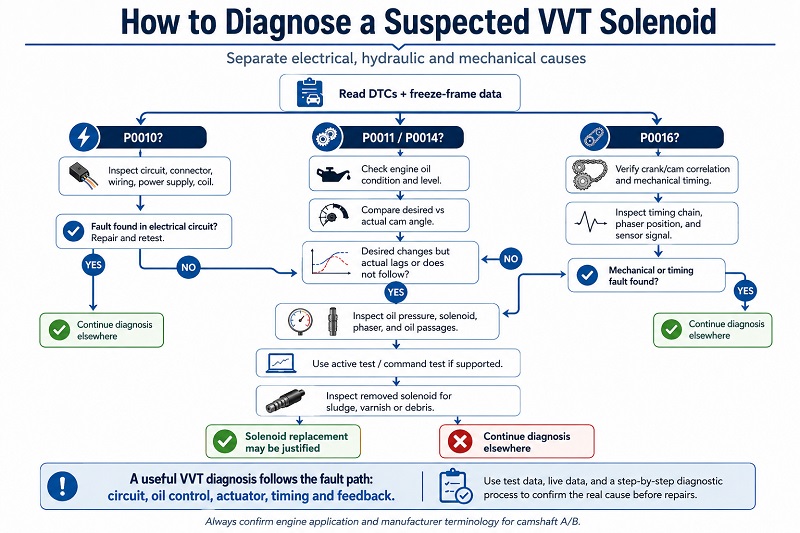
Record every DTC before clearing anything. P0010 points toward the electrical circuit first. P0011 or P0014 call for a cam-control performance check. P0016 makes mechanical correlation the priority.
Also confirm the engine code and whether the fault refers to intake or exhaust, Bank 1 or Bank 2 — the same vehicle model can run different engines, VVT layouts and calibrations across model years.
Hydraulic VVT lives or dies on the lubrication system. Oil level needs to be correct and the grade needs to match spec; heavy contamination, sludge or restricted passages can stop the control valve and phaser from responding no matter how healthy the solenoid is electrically.
Oil pressure matters just as much — a solenoid can be electrically perfect and still fail to produce the requested movement if the hydraulic supply behind it is weak. Subaru's P0016–P0019 workflow reflects this: it checks oil level and condition, then calls for an oil-pressure test before moving on to strainers and VVT oil passages.
Watching what the ECU wants against what the camshaft actually does is one of the strongest tests available. If desired angle changes and actual angle follows closely, the hydraulic system is responding. If actual position barely moves, responds slowly, or stays offset, move the investigation toward oil supply, the solenoid, the phaser or mechanical timing.
Kia's CVVT training uses actual-vs-desired position as its diagnostic method rather than relying on a stored code alone. What counts as an acceptable deviation has to come from the correct service information — there's no universal "more than X degrees means the solenoid is bad" rule.
OEM procedures show how application-specific these numbers get. Subaru's diagnostic procedure for P0016–P0019 on certain Impreza and XV Crosstrek models doesn't use a simple degree threshold at all — it calculates a value from separate intake and exhaust VVT angle readings against a formula in the service bulletin, and treats a harness resistance reading above the specified limit as grounds for repair.
Coil resistance can catch an open or shorted winding when the manufacturer publishes a spec, but a good coil reading doesn't prove the spool can move or meter oil correctly. Applying battery voltage directly to an unknown solenoid isn't a safe universal test either — ECU-controlled valves often have application-specific electrical behavior and duty-cycle strategies.
Where the scan tool supports it, an active test that commands the VVT system while watching actual camshaft response tells you more than either of those shortcuts.
Once removed, the solenoid often tells you more than any electrical test could. Sludge, varnish, metallic debris or a damaged filter screen can restrict oil movement, and a spool that binds mechanically can still show a normal coil reading while failing to meter oil.
If there's significant metallic debris, a new solenoid alone isn't the fix — figure out where the debris came from and check the rest of the lubrication and timing system.
For P0016 especially, verify mechanical timing when the diagnostic procedure points that way. An elongated or jumped timing chain changes the physical relationship between crankshaft and camshaft, and no new solenoid fixes incorrect base timing. The same goes for a phaser that can't lock or mechanically return to where it belongs.
Replacement makes sense when the evidence points at the component itself: a clear electrical failure in the winding, a valve that fails the manufacturer's functional test, a physically stuck spool, or a solenoid confirmed not to route oil during a controlled test.
GM has documented specific applications where rough running, hesitation, hard starting and P0010/P0011/P0014-related faults traced to a confirmed camshaft actuator solenoid failure, with replacement prescribed after the bulletin's criteria were met.
Replacement is a much harder case when oil pressure is low, mechanical timing is off, a wiring fault hasn't been resolved, or desired and actual cam angles show the VVT system is already responding normally.
Finding | Replacement Decision |
Solenoid circuit is electrically open/shorted per spec | Replacement may be justified once wiring is ruled out |
Solenoid spool sticks or fails functional test | Strong case for replacement |
Significant restriction or damage inside the solenoid that the repair procedure can't correct | Replacement may be justified |
P0010 with damaged wiring or connector | Repair the circuit first |
P0011/P0014 with low oil pressure | Fix the oil-pressure problem before condemning the solenoid |
P0016 with incorrect timing-chain alignment | Mechanical timing repair takes priority |
Cold-start rattle with confirmed phaser wear | Phaser/timing diagnosis takes priority |
Solenoid works correctly during active test, actual cam follows desired cam | Keep diagnosing elsewhere |
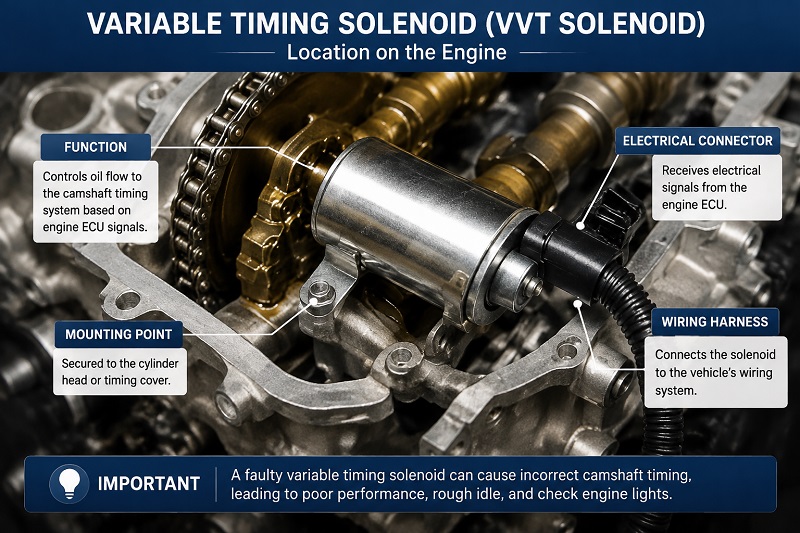
Pulling most VVT solenoids is the easy part. What happens before installation matters more.
Go back over the diagnostic evidence first. If the code was circuit-related, make sure wiring and connectors weren't mistaken for the solenoid. If the complaint was slow cam response, confirm oil supply and phaser condition were actually checked. If P0016 was present, confirm mechanical correlation wasn't skipped. Replacing the easiest part isn't the same as diagnosing the system.
The condition of the old valve can explain a lot. A heavily contaminated screen points to oil condition or upstream contamination that needs attention. Metallic particles are worth more concern than ordinary varnish, since they can indicate wear elsewhere in the engine. Don't install a new valve into an unresolved restricted-oil condition.
Most VVT solenoids seal with an O-ring or similar elastomeric seal. Remove the old seal fully and check the sealing surface for damage or contamination — otherwise an installation leak can show up immediately even on a perfectly good replacement solenoid. Use the manufacturer's lubrication, seal and torque procedure rather than a generic value.
Clearing the code isn't the finish line. Once the repair's done, check for oil leaks and rescan the ECU. Where scan data allows it, compare desired and actual camshaft positions again under the same conditions that originally exposed the problem. If the code comes back, go back to diagnosis instead of reaching for another part.
For aftermarket buyers, "fits this vehicle model" isn't specific enough. A single engine can use separate intake and exhaust valves, different part revisions, or different connector and oil-port arrangements, and a vehicle series can run several engines across countries and production years. The strongest starting point is the OE reference number off the removed component, checked against engine code and installation position.
Purchasing Check | What Needs to Be Confirmed | Why It Matters |
OE reference number | Original number and verified supersessions | Prevents cross-application errors |
Engine code | Exact engine family and displacement | Vehicle model alone may cover several VVT systems |
Intake / exhaust position | Which camshaft the valve controls | Intake and exhaust solenoids may not be interchangeable |
Bank position | Bank 1 or Bank 2 where relevant | Important on multi-bank engines |
Connector geometry | Pin count, keying and orientation | Similar housings can use different electrical interfaces |
Valve/spool dimensions | Overall length and control-valve geometry | Determines oil-port alignment and hydraulic operation |
Oil-port / screen arrangement | Number and location of ports and filtration screens | Affects how oil is routed to the phaser |
Seal specification | O-ring dimensions and material | Incorrect sealing can create oil leakage |
Electrical specification | Application-specific coil/control characteristics | Physical fit doesn't guarantee correct ECU control |
Application cross-reference | Vehicle year, engine and OE supersession | Reduces incorrect catalog matching |
Batch traceability | Production lot and inspection records | Supports repeat orders and warranty investigation |
Two solenoids can share diameter, mounting tab and connector shape while running completely different control characteristics. Aftermarket validation needs to go past "does it fit in the head" — ask how the supplier confirms OE cross-references, electrical characteristics, spool movement, oil-port geometry, sealing dimensions and functional response.
Some engines use identical valves in both positions. Others don't. If the parts carry separate OE numbers, the quote, product label and carton should clearly state intake or exhaust — this matters most for distributors carrying multiple variants under one vehicle family.
A newer OE number doesn't always mean the physical part matches every earlier revision. When a number has been superseded, confirm the replacement covers the same engine range and camshaft position. For uncertain applications, comparing the old component against a sample before a bulk order cuts down on returns and installation disputes.
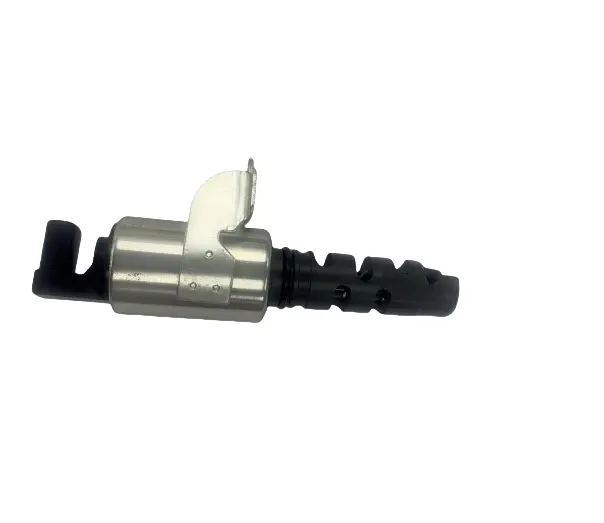
Huizhan supplies aftermarket replacement variable timing solenoids for selected engine applications. The replacement solenoids are made to OE-standard quality and application requirements, aiming for equivalent fit, function and operating performance to the original component when the correct OE reference and engine application are confirmed.
For bulk sourcing, buyers can send the OE number, engine code, intake/exhaust position, production information and original-part photos before quotation.
Related product information:
Variable Timing Solenoid
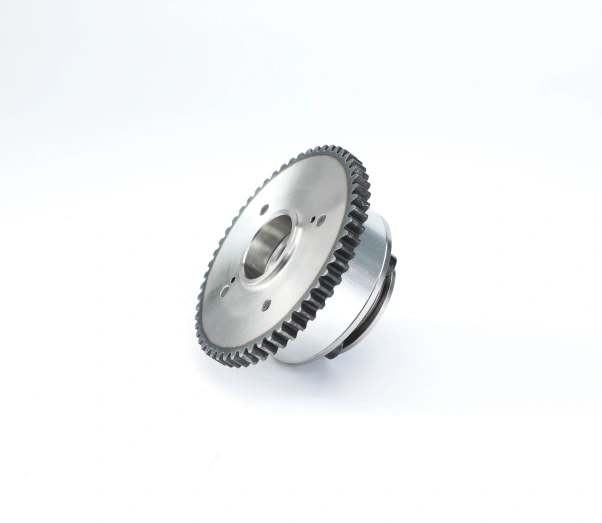
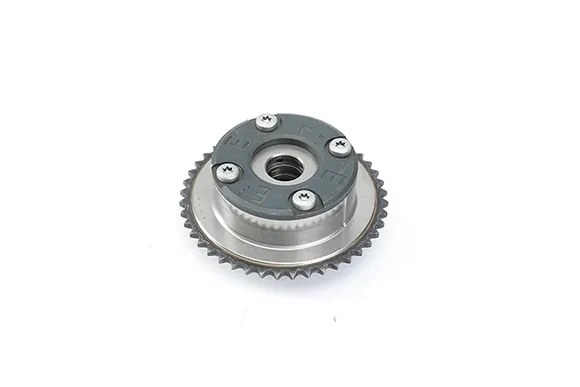
The two categories should be evaluated separately — the solenoid controls hydraulic oil flow, the phaser performs the mechanical camshaft-angle adjustment.
Yes, but the code alone doesn't prove it. A sticking oil-control valve can create an over-advanced or performance condition, but so can contaminated oil, low oil pressure, a worn phaser, incorrect mechanical timing, or manufacturer-specific software behavior. Compare commanded and actual camshaft position before condemning the solenoid.
Not necessarily. P0016 describes crankshaft-to-camshaft correlation, and timing-chain position, chain wear, phaser condition, sensor accuracy and oil-controlled cam timing can all be involved. A P0016 repair should include mechanical correlation checks whenever the manufacturer's procedure calls for them.
Contaminated oil and deposits can interfere with the control valve's movement and restrict the small VVT oil passages. Oil condition, viscosity and pressure are all part of the hydraulic control system, so check them whenever camshaft response looks abnormal.
Indirectly, if oil control to the phaser is abnormal. But rattling or ticking can also come from a worn phaser, timing chain, tensioner, or low oil pressure — localize the noise before replacing the solenoid.
Only if the manufacturer confirms the parts and positions are interchangeable. Swapping different part numbers or calibrations can create new faults and muddy the diagnosis.
Before replacement, work out whether the fault is electrical, hydraulic or mechanical. For P0010, check the solenoid circuit and wiring. For P0011 or P0014, compare commanded and actual camshaft position while checking oil condition and hydraulic supply. For P0016, give mechanical cam/crank correlation the attention it needs instead of treating the code as a direct solenoid diagnosis.
If the component itself is confirmed defective, inspect oil passages and sealing condition before installation, then verify actual VVT operation after the repair. For aftermarket purchasing, confirm the OE number, engine code, camshaft position, bank, connector, valve dimensions, oil-port arrangement and seal specification before ordering.


 English