A metallic rattle after starting, delayed starting or an implausible camshaft-position reading may lead a workshop to suspect Mercedes M271 camshaft adjuster problems. The adjuster may be involved, but these symptoms can also result from an elongated timing chain, a weak tensioner, incorrect mechanical timing, restricted oil control or an electrical fault.
The M271 timing system combines the timing chain, intake and exhaust camshaft adjusters, oil-control components, camshaft sensors and engine-management system. Diagnosis should establish whether the fault is mechanical, hydraulic or electrical before replacement parts are selected.
For M271 EVO engines, Mercedes-Benz issued technical guidance covering a two-to-five-second rattle after starting and several camshaft-position plausibility faults. The procedure calls for timing-chain measurement before choosing between tensioner replacement and a wider timing-chain repair.
Direct answer: An M271 start-up rattle does not prove that the camshaft adjuster has failed. The timing chain, tensioner, adjuster, oil-control system and basic mechanical timing should be assessed together.
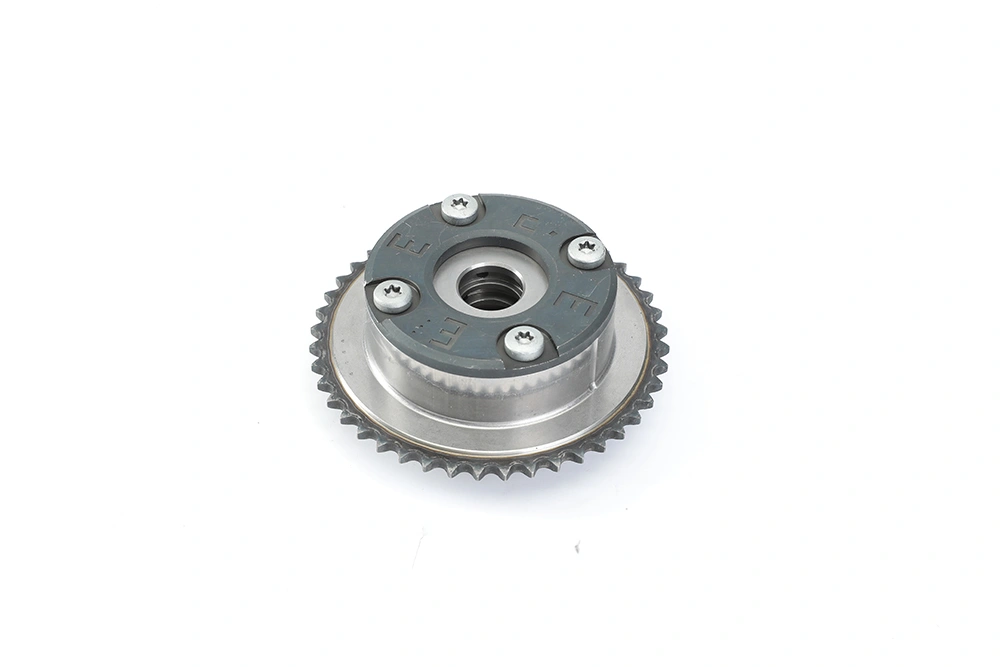
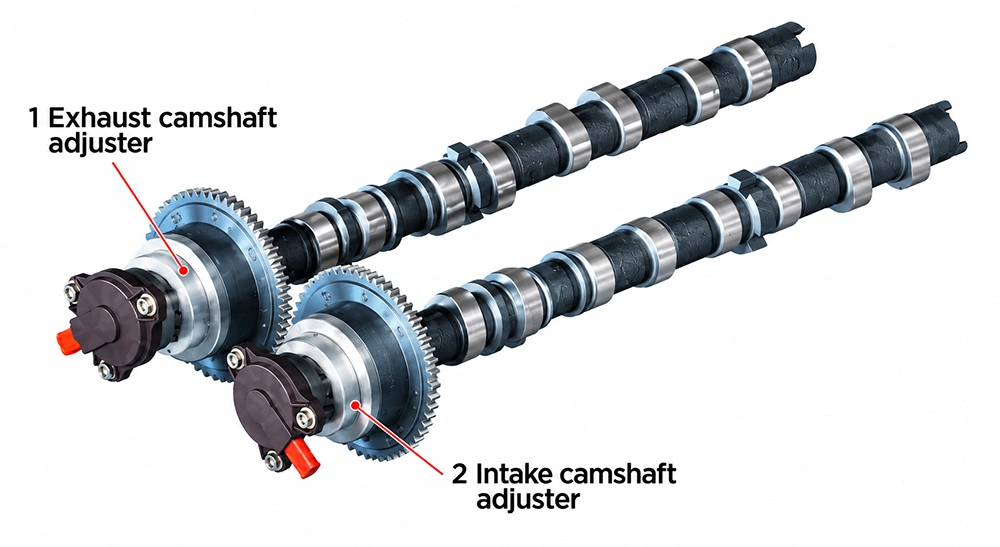
The camshaft adjuster changes the angular position of the camshaft relative to the timing drive. This allows the engine control unit to alter valve timing as engine speed and load change.
Oil flow controlled through the variable valve timing system moves the internal mechanism. Camshaft-position sensors then report the actual camshaft position so that the control unit can compare it with the requested position.
The adjuster does not control timing alone. Its operation depends on correct crankshaft-to-camshaft mechanical timing, suitable timing-chain tension, controlled oil flow, working solenoids or valves, accurate camshaft-position signals and usable internal adjuster components.
A problem in any of these areas can prevent the camshaft from reaching or holding the requested position.
M271 parts are frequently described using overlapping names. This creates ordering errors and can also confuse fault diagnosis.
A leaking or electrically faulty adjuster magnet is not the same failure as mechanical wear inside the camshaft adjuster. Replacing one does not automatically correct a fault in the other.
This distinction is particularly important when customers request a “camshaft sensor”, “cam gear” or “VVT valve” without supplying an OE number or photograph.
| Term | What it usually refers to | What it does |
| Camshaft adjuster | Mechanical and hydraulic timing unit attached to the camshaft drive | Changes camshaft angle |
| Camshaft sprocket or timing gear | Toothed outer section or, in some catalogues, the complete adjuster assembly | Transfers timing-chain movement |
| Camshaft-adjuster magnet | External electromagnetic control component on relevant versions | Controls oil flow or valve movement |
| VVT solenoid | General term for the oil-control actuator | Directs hydraulic control |
| Camshaft | Shaft carrying the valve-operating lobes | Opens and closes the valves |
| Camshaft-position sensor | Electrical position-monitoring component | Reports camshaft position |
A brief metallic rattle from the chain-drive area may indicate that the timing chain and hydraulic components are not controlling the camshafts correctly during the first moments after starting.
For the M271 EVO applications covered by Mercedes technical guidance, the documented complaint is a rattle lasting approximately two to five seconds. The stated possible cause is timing-chain elongation, and the prescribed repair route begins with chain measurement rather than automatic adjuster replacement.
A start-up rattle may involve timing-chain elongation, chain-tensioner operation, worn sprocket or adjuster components, delayed hydraulic control, incorrect previous assembly or more than one worn timing component.
The workshop should record whether the noise occurs after an overnight stop, after a short warm stop or on every start. A cold-start recording can provide useful evidence because the noise may have disappeared before the vehicle reaches the workshop.
If the camshaft position is outside the expected range, the engine may crank for longer before starting. A Japanese recall notice covering certain M271 EVO vehicles stated that mechanical wear could impair camshaft-adjuster function, initially producing noticeable start-up noise and, with further wear, delayed starting and an illuminated engine warning lamp.
Long cranking is not specific to the adjuster. Fuel pressure, ignition, crankshaft signals and other engine-management conditions should also be considered.
Codes such as P0016 or P0017 indicate that the control unit has detected an implausible relationship between camshaft and crankshaft position. They do not state that the adjuster is the only possible cause.
Possible causes include chain elongation, incorrect mechanical timing, worn adjuster components, a camshaft-position signal fault, an oil-control problem or a control-circuit fault.
The full manufacturer-specific code and subcode are more useful than the generic five-character code. Mercedes documentation for M271 EVO engines lists several subcodes describing commanded positions that cannot be reached, implausible signal comparisons and incorrect mechanical setup.
Detailed P0016, P0015 and P0340 interpretation should remain on the existing Mercedes fault-code page.
Incorrect valve timing may affect idle stability, combustion and throttle response. However, rough running can also result from ignition, fuelling, intake leaks or other control faults.
Timing-system diagnosis should be based on scan data and mechanical evidence rather than drivability symptoms alone.
| Symptom | Possible timing-related causes | Useful next check |
| Two-to-five-second start-up rattle | Chain elongation, tensioner operation or adjuster wear | Record the noise and inspect the mechanical timing system |
| Long cranking | Camshaft-position error or unrelated starting fault | Review full fault data and starting conditions |
| Camshaft position does not reach target | Adjuster, oil control, solenoid or mechanical timing | Compare requested and actual camshaft position |
| Camshaft/crankshaft correlation fault | Chain elongation, timing error or position-signal problem | Verify basic mechanical timing |
| Rough idle or poor response | Incorrect timing or unrelated engine-management fault | Check timing data alongside ignition, fuel and air systems |
| Oil around an adjuster magnet connector | Magnet seal or related oil-leak issue | Inspect connector and wiring for oil migration |
The adjuster contains mechanical surfaces that must move and hold their position accurately. Wear may create excessive movement, prevent the mechanism from locking correctly or stop the camshaft from reaching its requested angle.
Evidence may include abnormal movement found during inspection, visibly worn working surfaces, damaged sprocket teeth, repeatable position errors with correct basic timing, noise traced to the adjuster or a removed component that fails the applicable inspection.
Certain M271 EVO vehicles were subject to an official Japanese campaign because mechanical component wear could impair adjuster operation. This supports adjuster wear as a genuine failure mode, but the campaign applied only to defined vehicles and should not be generalised to every M271 engine.
The chain establishes the mechanical relationship between the crankshaft and camshafts. As it elongates, the camshaft positions can move outside the range expected by the control system.
Mercedes’ M271 EVO procedure measures chain condition with a specified measuring tensioner. The result determines whether the repair path involves a replacement tensioner or timing-chain replacement followed by visual inspection of the intake and exhaust camshaft sprockets.
This confirms an important diagnostic principle: a start-up rattle and timing-position code should not lead directly to sensor or adjuster replacement before chain condition has been considered.
The variable valve timing system depends on controlled engine-oil flow. Sludge, restricted passages, unsuitable oil condition or contamination in a control component may interfere with adjuster response.
Oil condition should be inspected, but an oil change should not be presented as a repair for mechanical adjuster wear. Fresh oil cannot restore damaged teeth, worn locking surfaces or an elongated chain.
Check oil level and condition, service history, filter condition, visible sludge, oil-control component contamination, accessible oil passages and signs of previous sealant use.
A damaged connector, faulty control circuit or unstable position signal can create camshaft-control faults even when the mechanical adjuster remains usable.
Inspect adjuster-magnet or solenoid connectors, camshaft-position sensor connectors, wiring near the cylinder head, oil inside the connector or harness, damaged pins, supply and control signals, and stored code status with freeze-frame information.
Electrical checks should follow the wiring data for the exact vehicle. A resistance measurement by itself may not identify a mechanically sticking oil-control valve.
“M271” covers several engine variants. Earlier supercharged engines and later M271 EVO turbocharged engines do not necessarily use the same adjusters, timing parts or diagnostic procedures.
Record the full engine code, VIN, production date, vehicle model, intake or exhaust side, recent repair history, and oil and filter history.
The Mercedes start-up-rattle bulletin applies specifically to 271.8 EVO engines and lists engines including 271.820, 271.860 and 271.861. Its measurements and part references should not be transferred automatically to earlier M271 variants.
Before clearing faults, save the full Mercedes fault descriptions, subcodes, current or stored status, freeze-frame information, requested camshaft position, actual camshaft position and relevant adaptation values.
A control unit may report that a commanded position cannot be reached, that the mechanical setup is incorrect or that the camshaft signal is implausible relative to the crankshaft. These descriptions point towards different inspection priorities.
Requested-versus-actual data can show whether the camshaft responds to a control command.
A fixed offset may direct attention towards mechanical timing. Slow movement may involve hydraulic control or internal wear. An unstable signal may require sensor and wiring checks.
The figures should be interpreted using engine-specific information. One universal angle or adaptation limit should not be applied to every M271 version.
Inspect the external control components before opening the timing drive.
Look for oil in electrical connectors, damaged seals, broken wiring, contamination, loose connections, unsuitable or heavily degraded oil, and previous repair debris.
This stage helps distinguish a control fault from a mechanical adjuster or chain problem.
Where scan data, noise or starting behaviour points towards a real timing deviation, inspect the chain, guides, tensioner and adjusters as one system.
Use the correct locking, measuring and turning procedures for the engine. Improperly moving the crankshaft or camshafts can lead to incorrect timing and possible internal engine contact.
The Mercedes M271 EVO bulletin uses a specific chain-measurement procedure and separates the repair into different paths according to the measured result. This manufacturer-led sequence provides stronger evidence than visual judgement alone.
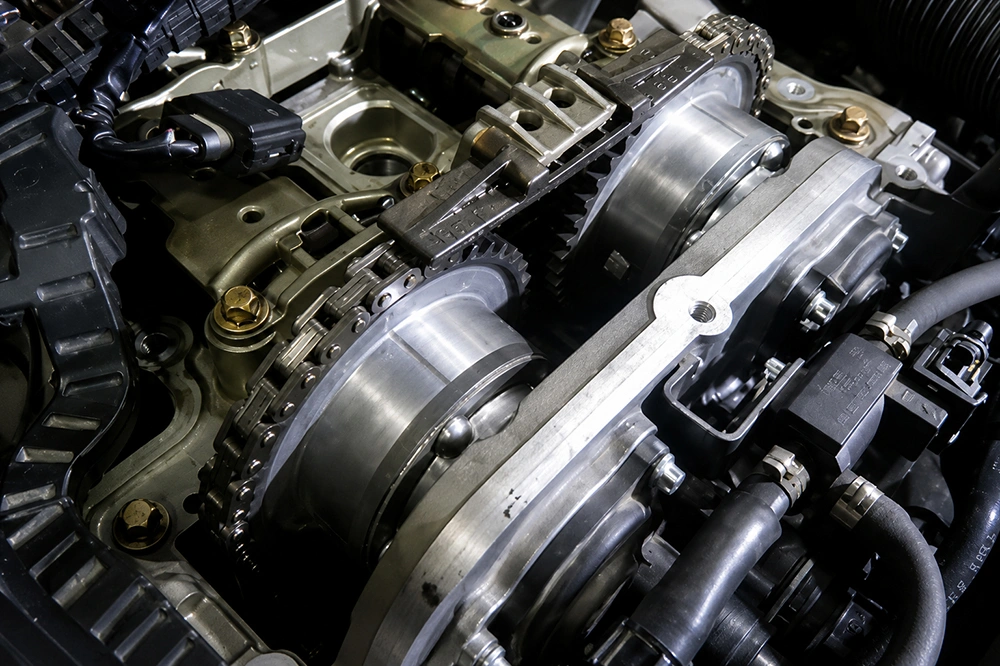
The camshaft adjuster should be replaced when inspection confirms that it cannot hold or achieve the required position, has excessive internal movement, has damaged working surfaces or is the identifiable source of the timing noise.
Mercedes-Benz USA extended camshaft-adjuster warranty coverage for certain 2012–2015 C250, C250 Coupe and SLK250 vehicles using the M271 engine. Claims required short-test fault documentation, and returned adjusters were subject to inspection. This reinforces the need for recorded evidence before replacement, although the programme was limited by market, model and warranty period.
The timing chain should be replaced when the applicable measurement or inspection confirms elongation or damage. A chain should not be added automatically because an adjuster is being changed, but it should not be left in service when its condition explains the timing error.
The adjuster magnet or VVT control component should be replaced when electrical testing, leakage inspection or functional checks confirm its fault. It should not be confused with the mechanical adjuster.
A complete repair does not always require every timing-system component. It does require an explanation for every component that is replaced or retained.
| Component | Replacement evidence | Related checks |
| Camshaft adjuster | Internal wear, damaged surfaces, excessive movement or inability to control camshaft position | Chain, tensioner, sprocket teeth, oil control and camshaft |
| Timing chain | Measured elongation, damage or incorrect mechanical timing | Guides, tensioner and both adjusters |
| Chain tensioner | Failed hydraulic control, wear or incorrect extension | Chain measurement and guide condition |
| Camshaft | Damaged lobes, journals, locating surfaces or adjuster interface | Oil supply and adjuster attachment |
| Adjuster magnet or VVT solenoid | Electrical failure, leakage or confirmed sticking | Connector, wiring and oil contamination |
| Camshaft-position sensor | Incorrect signal confirmed by testing | Wiring, trigger feature and mechanical timing |
Do not select an adjuster using only “M271”, vehicle displacement or model name. Confirm the complete engine code and whether the required part is for the intake or exhaust camshaft.
Record the VIN and production date, full OE number and suffix, intake or exhaust position, photographs of the front and rear faces, sprocket and tooth profile, central bolt or valve arrangement, mounting interface, timing marks, visible wear, and related fault and inspection findings.
For a parts quotation, state whether the supply includes the adjuster only, a central valve or bolt, seals, solenoid or magnet, timing chain, tensioner, guides and one-time-use fasteners.
For repeat aftermarket purchasing, cross-reference control matters as much as external appearance. Buyers should check application data, batch identification, machining consistency, protective packaging and the procedure used to investigate returns.
Before assembly, confirm that the engine-specific repair procedure is available, mechanical timing has been verified, chain and tensioner condition have been assessed, control components and connectors have been checked, oil condition and contamination have been considered, mating surfaces and oil passages are clean, replacement parts match the removed components, and the reason for each replacement part has been recorded.
After installation, follow the specified timing verification, priming and adaptation procedures. Recheck stored faults and actual camshaft behaviour to confirm that the original deviation has been corrected.
It changes the intake or exhaust camshaft angle relative to the timing drive. Oil control moves the adjuster, while the engine control unit monitors the result through camshaft-position signals.
No. The adjuster is the mechanical and hydraulic timing unit. The adjuster magnet or VVT solenoid is an external control component that influences oil flow on relevant engines.
No. Chain elongation, tensioner operation, adjuster wear and hydraulic control can produce similar noise. Relevant M271 EVO procedures call for chain measurement before the repair route is selected.
No. P0016 indicates an implausible crankshaft-to-camshaft relationship. Mechanical timing, chain condition, adjuster operation, sensor signals and wiring should be checked.
Yes. Contamination or restricted oil flow can interfere with hydraulic control. It cannot, however, restore worn adjuster surfaces or an elongated timing chain.
Not automatically. Inspect both sides, but base replacement on the engine version, physical condition, diagnostic evidence and labour scope.
Replace it when the applicable measurement or inspection confirms elongation, damage or incorrect timing. A new adjuster will not correct a stretched chain.
Provide the engine code, VIN or production details, intake or exhaust position, full OE reference and clear photographs of the removed component.

 English