The same behaviour can result from an eccentric shaft position signal problem, oil contamination at an electrical connector, damaged wiring, a faulty Valvetronic servomotor, failed adaptation or mechanical wear between the motor drive and eccentric shaft.
That distinction matters because replacing the shaft is a substantial mechanical repair. Fault memory and symptoms should be treated as the beginning of the diagnosis, not as confirmation that a new shaft is required.
For BMW engines using Valvetronic, the practical question is: Can the DME accurately determine eccentric shaft position, and can the servomotor move the shaft through its required range without an electrical or mechanical fault? The tests below help answer that question.
BMW Valvetronic changes intake valve lift according to engine operating conditions.
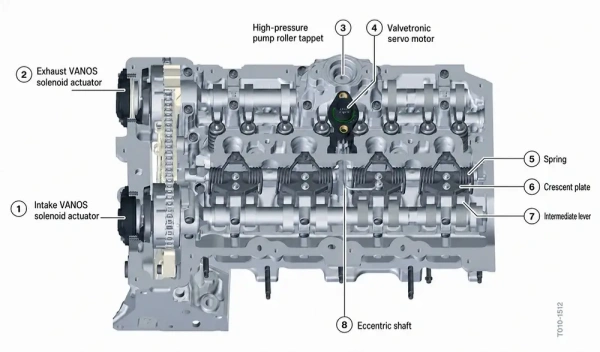
The basic mechanical path is: DME command → Valvetronic servomotor → worm drive → eccentric shaft → intermediate lever → intake valve lift.
Instead of relying primarily on the throttle plate to regulate engine load, the DME commands the Valvetronic motor to rotate the eccentric shaft. The shaft changes the geometry acting on the intermediate levers, which changes intake valve lift.
Position feedback lets the DME determine whether actual shaft movement corresponds with the requested position. This explains why a Valvetronic problem can come from several different areas.
Component | Function | Possible fault behaviour |
Eccentric shaft | Mechanically changes intermediate-lever geometry | Wear, binding, excessive play or damaged drive teeth |
Position sensing | Reports eccentric shaft position | Implausible or intermittent position data |
Valvetronic servomotor | Rotates the eccentric shaft | No movement, slow movement, electrical fault or drive wear |
Wiring/connectors | Carry power and position/control signals | Open circuit, poor connection, contamination or damaged terminals |
DME | Commands and monitors Valvetronic operation | Stores plausibility, adjustment and activation faults |
The exact component layout varies by engine generation.
For example, BMW's N20 technical training material states that its Valvetronic III eccentric shaft sensing is integrated into the servomotor. The N55 also uses an integrated sensor system in the Valvetronic servomotor. This is different from N51/N52 applications covered by BMW Service Information Bulletin SI B11 06 16, where a separate eccentric shaft sensor and its connector are specifically part of the diagnostic procedure.
For that reason, a diagnostic method that applies to an N52 should not automatically be applied to an N20, N55 or B48.
A mechanical eccentric shaft problem can produce drivability symptoms, but none of the following should be treated as proof of shaft failure on its own.
If commanded valve lift and actual Valvetronic position no longer correspond correctly, the engine may run unevenly or the DME may change its engine-load control strategy.
Before blaming the shaft, check for:
· Valvetronic fault codes
· position plausibility faults
· servomotor faults
· wiring or connector problems
· failed Valvetronic adaptation
· intake leaks and other causes of rough running
BMW's SI B11 06 16 specifically lists rough engine running as a possible customer complaint associated with eccentric shaft sensor plausibility faults on N51/N52-family applications.
A Valvetronic fault can sometimes result in an engine that cranks but does not start. Again, this is not specific to a worn eccentric shaft. Position feedback, motor control and other engine-management faults must be checked.
BMW's bulletin covering N51, N52, N52K and N52T applications lists crank-no-start alongside 2A37, 2A47 and, on specified F10/F25 vehicles, 134E08.
If the DME cannot reliably control Valvetronic movement, it may restrict engine operation and store additional adjustment or actuator faults. The driver may notice:
· reduced acceleration
· poor throttle response
· drivetrain malfunction warnings
· restricted engine operation
· recurring Valvetronic faults after clearing the DME memory
These symptoms justify diagnosis of the system, not automatic eccentric shaft replacement.
Repeated clicking from the Valvetronic drive area can be more useful diagnostically when combined with movement faults.
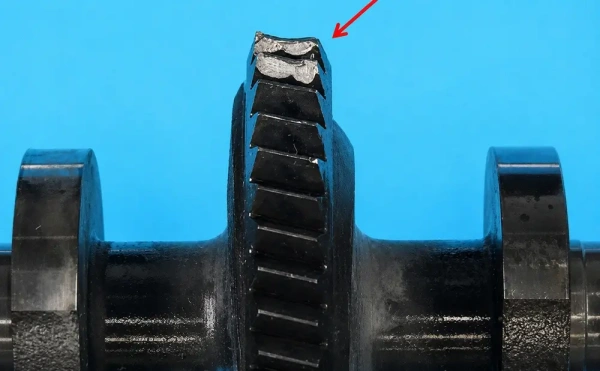
On engines such as the N55, mechanical wear can occur where the servomotor worm drive engages the eccentric shaft gearing. Visible deterioration of these surfaces provides much stronger evidence of mechanical failure than noise alone.
Noise can also originate elsewhere in the cylinder head, so the source should be identified before parts are ordered.
A fault code describes the condition detected by the DME. It does not necessarily name the physical component responsible. This is especially relevant to plausibility faults.
BMW SI B11 06 16 provides unusually clear evidence for this distinction. For applicable N51, N52, N52K and N52T engines, BMW lists:
BMW fault | BMW description in the bulletin | First diagnostic direction |
2A37 | Valvetronic, eccentric shaft sensor plausibility | Inspect eccentric shaft sensor connector for engine oil |
2A47 | Valvetronic, eccentric shaft, signal plausibility | Inspect sensor connector and continue diagnosis |
134E08 | Eccentric shaft plausibility | Same bulletin procedure; listed for F10/F25 only |
BMW identifies possible oil contamination at the VVT eccentric shaft sensor connector and/or DME connector as the cause addressed by this bulletin.
The procedure starts by inspecting the eccentric shaft sensor connector. If oil is found, the inspection continues towards the DME and engine harness.
A 2A37, 2A47 or 134E08 fault does not, by itself, establish that the eccentric shaft is mechanically worn. On the applications covered by this BMW bulletin, oil contamination and the position-sensing circuit must be investigated first.
135A08 appears in diagnostic references as a Valvetronic servomotor position-sensor signal plausibility fault.
It should therefore not be presented as a universal “eccentric shaft failure code”.
Depending on engine generation and accompanying faults, diagnosis may need to consider the integrated position sensing, servomotor, electrical circuit, actual movement of the shaft and mechanical drive. The surrounding fault memory is often more useful than one isolated code.
Depending on the BMW engine, DME version and diagnostic equipment, workshops may encounter faults describing conditions such as:
· no adjustment possible
· no movement detected
· adjustment range not learnt
· servomotor activation fault
· position signal implausible
· Valvetronic system deactivated after repeated adjustment faults
Do not build the replacement decision around a generic P-code translation alone. BMW-specific fault information and the applicable ISTA test plan provide more useful diagnostic context.
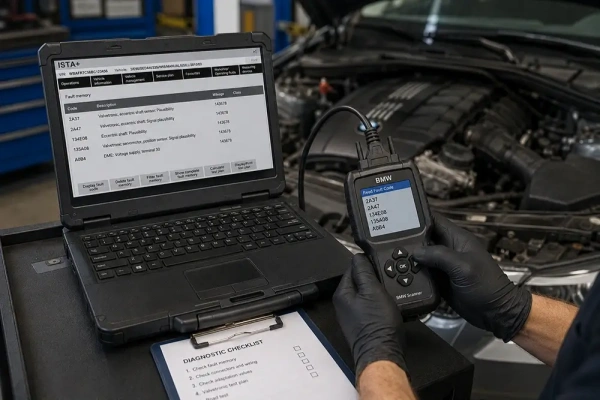
A useful diagnostic sequence separates four possible fault groups: signal → electrical control → actuator movement → mechanical wear.
Start with a BMW-capable diagnostic system rather than a generic code reader where possible. Record:
· every Valvetronic-related fault
· whether each fault is current or stored
· frequency or environmental data where available
· voltage-related faults
· servomotor activation faults
· eccentric shaft position/plausibility faults
· adaptation or limit-position faults
Do not clear the codes before recording them.
A plausibility fault accompanied by a motor activation or supply fault creates a different diagnostic path from an isolated position-signal fault.
Low system voltage should also be dealt with before interpreting actuator behaviour or running learning procedures.
This check is particularly relevant to the N51/N52-family design covered by BMW SI B11 06 16.
BMW's procedure for 2A37, 2A47 and 134E08 begins by disconnecting the VVT eccentric shaft sensor connector and inspecting it for engine oil.
If contamination is found, the diagnosis should not stop at the visible plug.
BMW's bulletin instructs the technician to inspect the DME and DME electrical harness connector as the next stage. The bulletin's repair path can involve the sensor, engine electrical harness, cylinder-head-cover gasket and, if oil has reached the DME connector, the DME itself.
This is why simply cleaning the connector and fitting an eccentric shaft may leave the actual fault unresolved.
Important: Do not generalise this N52-style connector check to every BMW Valvetronic generation. On N20 and N55 designs, the eccentric shaft sensing arrangement is integrated into the servomotor, and B-series applications also use later Valvetronic architecture.
Where the fault memory points towards position sensing or actuator control, inspect the relevant circuit before opening the engine for mechanical replacement. Look for:
· engine oil in connectors
· corrosion
· bent or damaged terminals
· loose terminal fit
· damaged insulation
· previous wiring repairs
· poor connector engagement
· open-circuit or supply faults
Circuit testing should follow the wiring diagram and test plan for the exact vehicle.
A Valvetronic servomotor consumes substantial current during operation. BMW's N55 technical training material describes a maximum servomotor actuation current of 40 A, illustrating why power supply, connector condition and circuit integrity matter when movement faults are being diagnosed.
Avoid applying generic resistance specifications from another engine or motor generation without checking BMW data for the exact application.
If the electrical inspection does not reveal the cause, use BMW-capable diagnostics to evaluate commanded and actual Valvetronic operation. Depending on the vehicle and software, useful checks can include:
· requested versus actual eccentric shaft position
· movement through the adjustment range
· limit-position or teach-in procedure
· adaptation status
· faults generated during movement
· whether the motor moves smoothly or stops at a repeatable point
A successful adaptation does not automatically prove every mechanical component is unworn. Equally, a failed learning procedure does not automatically prove the shaft needs replacing.
The failure needs to be interpreted alongside motor control, position feedback and mechanical behaviour.
Valve-cover removal and physical inspection become more relevant when:
· electrical supply and wiring check correctly
· position-sensing faults have been investigated
· Valvetronic learning repeatedly fails
· the motor cannot achieve the required movement
· movement is irregular or mechanically restricted
· abnormal drive noise is present
· faults return consistently during commanded movement
At that stage, inspect the mechanical interface rather than continuing to replace electronic components.
The servomotor and eccentric shaft operate as one mechanical drive, so their symptoms overlap heavily. The difference comes from testing.
Finding | Sensor/signal | Motor/electrical | Shaft/mechanical |
Oil inside applicable separate sensor connector | More likely | ||
Position plausibility fault without mechanical evidence | More likely | Possible | Possible |
Motor activation/supply circuit fault | More likely | ||
No commanded motor operation with confirmed power/circuit problem | More likely | ||
Learning fails despite correct electrical operation | Possible | Possible | More likely |
Motor moves but binds at a repeatable shaft position | Possible | More likely | |
Visible worn or damaged shaft drive teeth | Check motor gear too | More likely | |
Visible damaged motor worm gear | More likely | Check shaft gear too | |
Excessive mechanical play at the drive interface | Possible | More likely |
This table is a diagnostic direction, not a substitute for the BMW test plan.
· oil contamination at an applicable separate sensor connector
· an intermittent or implausible position signal
· wiring damage
· connector terminal problems
· no matching evidence of mechanical binding
For N52-family engines, BMW's own bulletin makes connector contamination an early diagnostic priority for 2A37, 2A47 and 134E08.
· motor activation faults
· supply or phase-related faults
· no actuator response despite a mechanically free system
· damaged motor drive components
· position-sensing problems on an engine where the sensor is integrated into the servomotor
N20 and N55 deserve particular attention here because their Valvetronic architecture integrates position sensing into the servomotor.
· visibly worn drive teeth
· damaged gear engagement surfaces
· mechanical binding
· excessive play
· a repeatable restriction in shaft travel
· wear affecting correct engagement with the motor worm drive
On an N55, the motor drive and eccentric shaft gearing should be inspected together. Installing a new motor against a badly worn mating surface can leave the original mechanical problem in place.
1. Read BMW-specific DME faults.
2. Identify the engine and Valvetronic generation: N52 with separate sensor, N20/N55 with integrated servomotor sensing, or B48 with later Valvetronic architecture.
3. Check battery/system voltage and relevant electrical faults.
4. Inspect connectors and wiring. For applicable N51/N52 faults, check the eccentric shaft sensor connector for oil and follow the contamination path towards the harness/DME if required.
5. Check Valvetronic position and commanded movement with diagnostic equipment.
6. Run the applicable test plan/limit-position learning procedure.
7. If electrical and signal checks pass but movement remains incorrect, inspect mechanically.
8. Inspect the motor drive, eccentric shaft gearing and associated Valvetronic components.
9. Replace only the components supported by the diagnosis, then complete the specified teach-in/run-in procedure.
This sequence prevents a common diagnostic error: interpreting “eccentric shaft plausibility” as “replace eccentric shaft”.
“BMW Valvetronic eccentric shaft” describes a component family, not one interchangeable part. BMW changed Valvetronic architecture across engine generations.
Engine | Diagnostic/parts consideration |
N52 family | Separate eccentric shaft sensor is relevant; BMW documents oil-contamination diagnosis on applicable vehicles |
N20 | Valvetronic III; eccentric shaft sensing is integrated into the servomotor |
N55 | Valvetronic III with integrated sensor system in the servomotor; inspect motor/shaft drive engagement when mechanical wear is suspected |
B48 | Later-generation Valvetronic architecture; part configuration and application must be checked by exact engine/vehicle data |
This difference matters both in the workshop and at the parts counter.
A buyer asking for an “eccentric shaft sensor” based only on a fault-code description may be requesting a component that is not separately serviceable on that engine configuration.
Once mechanical replacement is supported by diagnosis, fitment verification becomes the next source of avoidable errors. Do not identify the part from “BMW 2.0”, “BMW 3.0” or vehicle model alone.
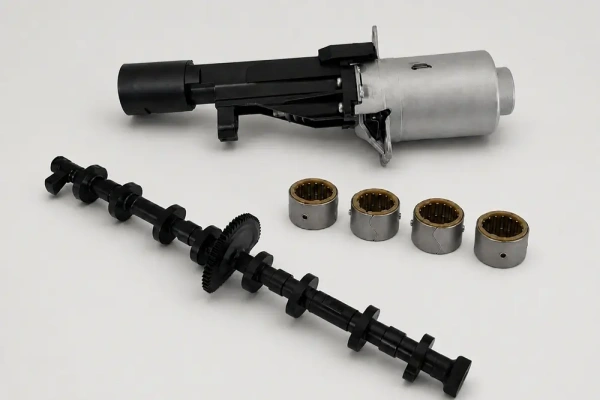
Confirm the full engine family and, where required, the exact variant. N20, N52, N55 and B48 eccentric shafts should not be treated as interchangeable because all four use Valvetronic.
BMW applications can change during a model's production run. Production date can be more useful than registration year when verifying a part.
Cross-check the BMW OE number and any valid supersession against the VIN/application data. For example, the N55/S55 eccentric shaft is commonly associated in aftermarket catalogues with BMW reference 11 37 7 589 883 / 11377589883, but that reference should still be checked against the exact vehicle before ordering. Do not select a shaft solely because it visually resembles the removed component.
Where motor or drive wear is involved, check the corresponding servomotor reference and its mechanical interface. If one side of the gear engagement is badly damaged, inspect the mating component before reusing it.
Depending on engine and repair scope, the workshop may also need to identify:
· Valvetronic servomotor
· eccentric shaft sensor where separately serviceable
· bearings or bearing-related components
· valve-cover/cylinder-head-cover gasket
· motor seal/gasket
· sensor seal where applicable
· specified single-use fasteners
· other parts required by BMW repair instructions
The repair list should be based on the exact engine rather than a universal “Valvetronic kit”.
For an aftermarket replacement eccentric shaft, buyers should look beyond application labels. Relevant supplier checks include:
· correct OE cross-reference
· accurate gear geometry
· consistent bearing and eccentric surfaces
· dimensional control
· surface finish
· material and heat-treatment consistency where specified
· inspection records
· batch traceability
· protective packaging for machined surfaces
For distributors and engine-parts buyers, these controls affect fitment complaints and return rates more directly than broad product claims.
Procurement item | Why it matters |
OE cross-reference | Prevents application errors |
Engine/application data | Separates similar BMW Valvetronic generations |
Production-date coverage | Reduces fitment disputes |
Shaft dimensions and gear profile | Affects mechanical engagement |
Batch traceability | Helps investigate repeat failures or claims |
Packaging protection | Prevents damage to machined and gear surfaces |
Consistent labelling | Reduces warehouse picking errors |
Related motor/repair-kit availability | Supports complete workshop orders |
For suppliers handling multiple BMW Valvetronic applications, clear application data is particularly important because a fault-code description does not necessarily identify which component the workshop ultimately needs.
Replacement is justified when diagnosis produces evidence of a mechanical shaft problem rather than merely a Valvetronic system fault.
· BMW's applicable diagnostic procedure identifies oil contamination
· the position sensor or its circuit has been confirmed faulty
· wiring or connector damage explains the plausibility fault
· there is no evidence of shaft wear or binding
· actuator electrical tests identify a motor/circuit fault
· the motor does not respond correctly
· its drive gear is damaged
· an integrated position-sensing fault is traced to the actuator assembly
· gear teeth or engagement surfaces are visibly worn or damaged
· the shaft binds mechanically
· shaft movement is outside specification because of confirmed mechanical wear
· excessive mechanical play prevents reliable Valvetronic adjustment
· the shaft has been physically damaged during a previous failure or repair
If both motor and eccentric shaft drive surfaces are damaged, replacing only one side may not restore correct engagement.
The consequence depends on the failure mode.
An intermittent sensor or connector fault may initially produce occasional warnings or poor running. A progressing motor/shaft drive problem can eventually prevent the system from reaching commanded positions.
Possible results include:
· recurring drivetrain malfunction
· reduced engine performance
· rough running
· starting problems
· repeated Valvetronic deactivation
· failed adaptation
· further wear at the motor/shaft interface
A vehicle with persistent Valvetronic faults, abnormal mechanical noise or starting problems should be properly diagnosed rather than driven until the failure becomes more severe.
Mechanical installation is not the end of the repair.
BMW service procedures for relevant Valvetronic systems specify diagnostic follow-up after servomotor work.
For example, a B46/B48 service procedure identifies the diagnostic path for teaching in the Valvetronic servomotor limit positions: Service functions → Drivetrain → Engine electronics → Adjustment functions → Teach in Valvetronic limit positions.
N55 service information similarly calls for a Valvetronic run-in procedure after assembly. The exact procedure depends on the vehicle, engine and diagnostic software.
After repair, a workshop should normally:
10. verify assembly and electrical connections
11. confirm correct battery voltage
12. run the applicable BMW Valvetronic teach-in/run-in procedure
13. read the fault memory again
14. check actual Valvetronic operation
15. confirm that relevant faults do not return
16. verify engine operation after the repair
Do not rely on a generic ignition or accelerator-pedal “reset” procedure when BMW diagnostic software specifies a service function for the application.
Use the engine code and VIN/application data, not model name alone.
One plausibility code is not enough to diagnose mechanical shaft wear.
On applicable N52-family vehicles, this includes checking for oil contamination according to BMW's published diagnostic guidance.
Visible gear damage, binding or excessive play carries far more diagnostic weight than a generic symptom.
Confirm OE number, production date, engine variant and related motor components before the repair begins.
For workshops and parts distributors, this diagnostic information also improves the parts enquiry. An order containing the VIN/application, engine code, OE reference and required repair scope is much less likely to result in an incorrect eccentric shaft or incomplete Valvetronic repair kit.
Yes. Mechanical Valvetronic problems can contribute to rough or unstable running because the system controls intake valve lift. However, rough idle alone does not confirm eccentric shaft failure. Sensor faults, wiring problems, servomotor faults, intake leaks, ignition problems and other engine faults need to be excluded.
No. BMW SI B11 06 16 defines 2A37 as an eccentric shaft sensor plausibility fault on the covered N51/N52-family applications. BMW instructs technicians to inspect the VVT eccentric shaft sensor connector for engine oil before proceeding further. The code alone is not evidence of mechanical shaft wear.
In BMW SI B11 06 16, 2A37 is listed as “Valvetronic, eccentric shaft sensor plausibility”, while 2A47 is listed as “Valvetronic, eccentric shaft, signal plausibility”. Both are included in BMW's oil-contamination diagnostic procedure for the applicable N51/N52-family vehicles.
Yes, on applicable engines using the separate sensor arrangement. BMW specifically identifies oil contamination of the VVT eccentric shaft sensor connector and/or DME connector in SI B11 06 16. If oil is found, the harness and DME connector may also require inspection.
Fault codes alone usually cannot make that distinction. Check the electrical circuit and commanded actuator operation first. If these checks do not identify the problem, mechanical inspection can reveal damaged motor gearing, worn eccentric shaft teeth, excessive play or binding. Inspect both mating drive surfaces when mechanical wear is present.
No. BMW's N20 technical training documentation states that the eccentric shaft sensor function is integrated into the Valvetronic servomotor. N52-family applications covered by SI B11 06 16 use a separate VVT eccentric shaft sensor and connector. Diagnosis and parts selection must account for this difference.
Relevant BMW service procedures require Valvetronic teach-in or run-in functions after certain servomotor or mechanical repairs. The procedure depends on engine generation. BMW-capable diagnostic equipment should be used according to the repair instructions for the exact vehicle.
Provide the VIN/application, engine code, production year or production date, existing OE number where available and the components required for the repair. For B2B orders, confirm OE cross-reference, application coverage, packaging, batch traceability and whether related servomotors, seals, bearings or repair-kit components are required.

 English
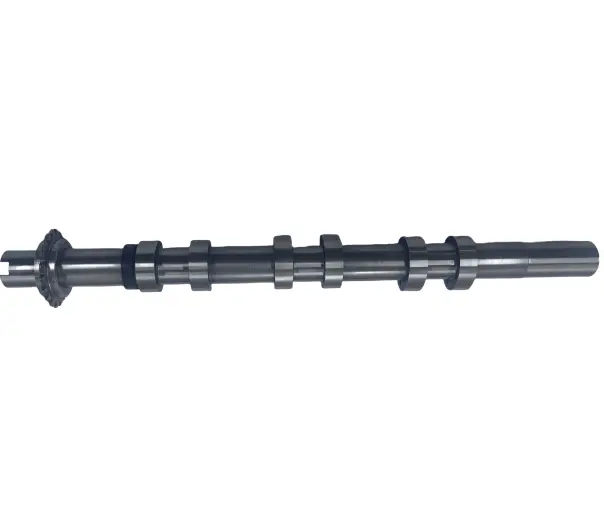
.webp "BMW N52 Valvetronic Eccentric Shaft-OE 11377515868")
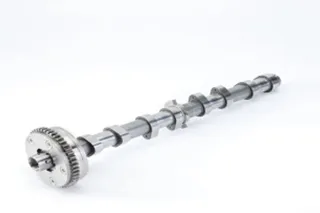
.webp "BMW N20 Valvetronic Eccentric Shaft-OE 11377630747")